Select a site alphabetically from the choices shown in the box below. Alternatively, browse sculptural examples using the Forward/Back buttons.
Chapters for this volume, along with copies of original in-text images, are available here.


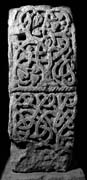
Object type: Shaft
Measurements: H. 107 cm (42 in); W. max. 46 cm (18 in) > 44 cm (17.5 in); D. 42 > 39 cm (16.5 > 15.5 in)
Stone type: Yellowish grey, poorly sorted, sparsely shelly, matrix-supported oolite. Ooliths mainly between 0.3 and 0.5 mm diameter, but some are up to 1.5 mm across; weather out to give 'aero-chocolate' texture. Platy shell fragments up to 4 mm across; other, small, fragments vary from platy to sub-rounded. Bath stone, Chalfield Oolite Formation, Great Oolite Group, Middle Jurassic
Plate numbers in printed volume: Pls. 268-71
Corpus volume reference: Vol 7 p. 163-4
(There may be more views or larger images available for this item. Click on the thumbnail image to view.)
A (broad): Small sections of cable moulding survive at the sides, and a complete line of cable divides the face into two panels. The base of the lower panel is hacked away, but above is an unruly pattern of twelve strand, median-incised interlace terminating in three pattern E knots. The upper panel is entirely filled with a bush-scroll which rises on a single stem from a stepped base, and then divides into asymmetrical scrolls with median-incised strands. On the left a volute terminates in two heart-shaped leaves and a long strand which bends upwards to branch again, into a stalk with a single leaf terminal, and a strand which coils back into a knot on the bottom right and again terminates in a single heartshaped leaf. The other main branch also throws off a volute, top right, terminating in a bud and two leaves, and a long strand which loops back and crosses the lower left volute, terminating in a single leaf. There are spacefilling pellets in the corners of the scroll.
B (narrow): Two pattern E terminals, and below a pair ofunruly knots with widely spaced median-incised strands. The pattern obviously continued to the right but was truncated when face C was cut away.
C (broad): Cut away
D (narrow): Chiselled away, but faint traces of a division into two panels; and in the upper, interlace, and possible plant-scroll.
E (top): Dowel hole filled with lead (diam. c. 4 cm).
The non-geometric unruly interlace, which is none the less cut confidently and with clever crossings, is of the same general type as on East Stour face C (Ill. 58), and there was possibly the same formula of alternating plant-scrolls and interlace as at East Stour and Gillingham 1 (Ills. 65–7). Whether one is to see the bush as an attempt at a more naturalistic rendering of branches, or an example of the freehand rendering of a bush-scroll which has gone astray, is difficult to decide. There are tangled scrolls at Gloucester (West 1984b, 43, ill. 24) but they are more symmetrical, and certainly Kelston 1 seems a different type of organisation from the symmetrical leafless scrolls on the round shaft from Winchester High Street (Tweddle et al. 1995, 331, ills. 679–82) or the shaft from Winchester Priors Barton (ibid., 333–4, ills. 687–90), which are similarly set on stepped bases but are more convincingly dated to the ninth century. Kendrick compared the leaves with those on the Fetter Lane sword pommel (1938, 189, pl. 79), which has been dated most recently to the late eighth century (Webster and Backhouse 1991, 221), and similar tiny heart-shaped leaves are to be found on the side of the Codford St Peter shaft (Ill. 427). The general shape of the leaves and the way they are joined to the stems has a family resemblance to the fruit bunches at Britford (Ills. 411–20). The ambiguity of leaves and berry bunches, where both are shaped in the same way, finds its earliest expression in this area at Britford, and this could result in a scroll in which the heart-shaped elements represent both fruit and leaves. The context of this piece then seems to fit best into the late eighth century. The significance of the single bush could be to recall the Tree of Life, and Jeffrey West has suggested (pers. comm.) that the stepped base may be a deliberate evocation of the Cross on Calvary. Certainly these scrolls could have a deeper resonance than the purely decorative (see introduction p. 55).
