Select a site alphabetically from the choices shown in the box below. Alternatively, browse sculptural examples using the Forward/Back buttons.
Chapters for this volume, along with copies of original in-text images, are available here.


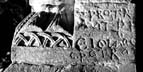
Object type: Inscribed stone reused as architectural feature
Measurements: H. of block: 19 cm (7.5 in); W. of inscribed face: 42 cm (16.5 in); W. of uninscribed face: 38 cm (15 in)
Stone type: Yellowish grey (5YR 7/2), poorly sorted, matrix-supported, bioclastic limestone. Clasts range mostly from 0.3 to 1.8 mm across and are mainly angular to sub-angular; a few elongate ones up to 3 mm, exceptionally up to 10 mm. Doulting stone, Upper Inferior Oolite Formation, Inferior Oolite Group, Middle Jurassic
Plate numbers in printed volume: Pl. 267
Corpus volume reference: Vol 7 p. 160-3
(There may be more views or larger images available for this item. Click on the thumbnail image to view.)
Holcombe 1 is a neatly dressed inscribed stone, which was re-used as the top-most stone of the right-hand jamb of the Romanesque south door of the nave of the twelfth-century church at Holcombe (Foster 1988; Okasha 1992a, 48–9, pl. IVb). The twelfth-century mason carved a capital for the jamb-shaft out of part of the block. The inscription is preserved on the uncarved section of the west face of the block between the capital and the door. In its Romanesque context the lettering was reset upside-down.
Inscription The inscription, which must pre-date its twelfth-century re-use, was incised onto a carefully dressed surface. Parts of four lines of text survive, but an uncertain number of letters was lost at the end of each line when the stone was trimmed for its present position. What remains of the text opens with a cross and it is likely, but not certain, that this was always the beginning of the inscription. The long uncarved area preceding line 4 (now the plain surface above the scallop-carving of the capital) indicates that nothing is lost from before the first surviving letter, of this line at least. One or more lines may originally have followed the fourth line.
[+P]ROT[R] —
—AT[ . . ] —
EIE[L . ]A[V] —
C:PET[R]A[ . ] —
The language appears to have been Latin but losses and damage have left the meaning obscure. The sequence PET[R]A in line 4 can plausibly be read as a form of the Latin petra ('stone'). Furthermore the preceding C and the vertical stroke at the end of the line, which could have formed part of a half-uncial or minuscule M, suggest the reading [HAN]C : PETRA[M] ('this stone' in the accusative case). In that case, the mid-line punctuation point would, if deliberate, have served no purpose other than to separate these words. If we accept that the language was Latin, the opening PRO is likely to have been either the preposition pro or the prefix pro-. The —AT of the second line, if taken as the end of a word, could represent a Latin verb terminating in -at (third person singular of either the indicative or the subjunctive depending onthe conjugation). The next symbol looks like a P with a long vertical crossed by a horizontal stroke. There is, however, a slight change in axis in the vertical either side of the horizontal. The pairs of nick-like strokes above the bowl of the 'P' and below the horizontal are probably accidental. If it is accepted that the original intention was a 'P' crossed by a horizontal, two possibilities suggest themselves in an early medieval Latin context. One is that the symbol represents the preposition per ('through' etc.) or the prefix per-. P with a horizontal cross-bar is the antique and 'Continental' form of the symbol and it can be found in Anglo-Saxon manuscripts from an early date and becomes the norm in the tenth century (Lindsay 1915, 175–83). (A distinct 'Insular' form is normal in Irish and Welsh manuscripts and is very common in earlier Anglo-Saxon manuscripts.) The following letter was either F or P, giving perhaps a Latin compound starting with perf- or perp-. Alternatively, the symbol might represent the 'monogrammatic cross' form of the monogram of the first two letters of Christ's name in Greek, chi and rho. This is, however, less probable, since this symbol normally appears either independently or at the opening of a text (Higgitt 1979, 349, 372 n. 16; Trench-Jellicoe 1998, 499–503).
The rest of the inscription is too fragmentary to allow for other than conjectural readings. As Foster (1988, 209–10) shows, the surviving letter sequences are compatible with a number of different personal names. It is, for example, possible that the EIEL of line 3 represents the first element of an Old English male or female name. Eiel- is an attested spelling of names which appear as Æþel- in normalised Old English.
Watkin (1969, 12–13) has also argued, less plausibly, for the presence of an Old English personal name in this inscription. He proposed that the first letter, here taken to be P, should be read as Old English wynn, which is sometimes indistinguishable in form from capital P, as, for example, at Great Edstone in Yorkshire (Okasha 1971 pl. 41; Lang 1991, 134–5, ills. 451–2). On this basis he reconstructed the first line as 'Wrotrard' (i.e. ǷROTR[ARD]), which he took to be a form of the Old English masculine personal name, Hrothweard. However, as Fran Colman (whose views are reported in Foster 1988, 208–9) has argued, this identification is unconvincing on both phonological and orthographic grounds.
The inscription could alternatively have contained one or more Brittonic names or names in Brittonic forms. Foster (1988, 209–10) reports suggestions from Professor William Gillies of Old Welsh names or name-elements that could possibly lie behind what remains of the inscription. These are in his view no more than possibilities, but cumulatively these possibilities are 'sufficient for a 'Celtic' origin [for the inscription] to be considered fairly seriously' (Foster 1988, 210).
The layout of the inscription is strikingly uneven and the letters are very uneven in height, ranging between the 1.5 cm of first O in line 1 and the 4.3 cm of the first E in line 3. The gap between lines 2 and 3 is much larger than those between lines 1 and 2 and between lines 3 and 4. It may perhaps have been intended to mark a division into separate sections. The uninscribed 'margin' to what was originally the left of the inscription is surprisingly broad but as the block was cut down at the time of its twelfth-century re-use, it is not possible to see how the inscription related to the stone as a whole in its original form.
The letters are boldly but unevenly incised, and some letters are finished off with serifs or at least the expansion and deepening of terminals. The details of the letter forms are not always well preserved. The following letters approximate to their 'Roman' capital forms: C, I, O, P, R and T. The bowls of P and R appear to be closed in each case. The As are probably to be classed as minuscule, although precise affinities are hard to pinpoint. E is a rounded letter similar to the uncial form and the three examples are set at rakish angles, twice tilted upwards towards the right and once dipping violently downwards. The fourth letter of line 4 is presumably derived from the sinuously curved L of Insular half-uncial. The vertical stroke at the end of line 4 seems to start at the top with a short lead-in stroke and may have formed the first stroke of an M, perhaps derived from the Insular half-uncial or minuscule letter. The truncated letter at the end of line 3 is most probably to be reconstructed as a rounded form of V, either the rounded capital (U) or a form derived from the half-uncial or minuscule letter.
Inscription An inscription available for reuse by the builders of the Romanesque doorway at Holcombe should be able to throw light on the literate culture of pre-Conquest Somerset. It is therefore frustrating that it is not more complete. We probably have the beginning of the text, marked by a more or less equal-armed ('Greek') cross. This is not, however, certain, since crosses can also appear at significant points within texts, as for example on ninth-century inscriptions at Yarm, Yorkshire, or on the 'Pillar of Elise' at Llantysilioyn-Ial, Denbighshire (Lang 2001, 274–6, ill. 1127; Nash- Williams 1950, 123–5; Bartrum 1966, 1–3 and plates). The text was almost certainly in Latin and, if so, can be taken to have included a statement about a stone, very probably as the object of a sentence (... [han]c petra [m]). Petra occurs fairly frequently in the Vulgate, most famously in the Peter/rock word-play of Matthew 16. 18 ('tu es Petrus, et super hanc petram aedificabo ecclesiam meam') and in the image of building on stone ('super petram' in Matthew 7. 24–5 and Luke 6. 48). More probably, however, the stone in question was the inscribed monument itself, although there are few clues as to its nature. Petra is not a word that is very frequently used in inscriptions. There are, for instance, six references for lapis ('stone') in the relevant index of the Inscriptiones Latinae Christianae Veteres but none for petra (Diehl 1925– 67, III, 544). In England the word is used in the inscription on a twelfth-century stone boundary-marker of the territory of Crowland Abbey: hanc petra( m) Guthlacus h (abe)t sibi metam (Okasha 1971, 62–3; Everson and Stocker 1999, 323–5). The indexes of the volumes of the Corpus des inscriptions de la France médiévale list a number of uses of petra in inscriptions of the eleventh to thirteenth centuries, principally referring to the stone of a tomb but sometimes also to the symbolic uses in Matthew and Luke (e.g. Favreau and Michaud 1978, 106, 139–40, 140–2, 224–5; Favreau, Michaud and Mora 1986, 46, 59–60, 63–4, 145–6; Favreau, Michaud and Mora 1995, 141–2). A twelfth-century lintel at Neuville-l?s-Decize echoes an antiphon from the dedication service, 'Hec est domus Domini firmiter edificata; bene fundata est supra firmam petram' (Favreau 1995, 382; Favreau, Michaud and Mora 1997, 32–3).
As has been seen, some of the surviving sequences of letters could have formed parts of personal names. On one hypothesis the text might have included an Old English name (Eiel-); alternatively it could have contained one or more names in Old Welsh forms.
Unfortunately, the surviving letter forms are not very diagnostic. The 'Roman' capital forms could have appeared at any period in the early Middle Ages. The most helpful letter is probably the L, if it is an L. This appears to be the Insular half-uncial letter. This can be found in manuscripts employing the Insular half-uncial script, most of which can be dated to between the seventh and ninth centuries. Comparable rounded forms of L appear in several Insular inscriptions. From Anglo-Saxon contexts there are examples in three inscriptions datable to between the mid eighth and the mid ninth centuries at Dewsbury, Falstone and Yarm (Okasha 1971, 65–6, 71–2, 130, pls. 30, 39, 145; Cramp 1984, 172–3; Lang 2001, 274–6, ill. 1127). Okasha's table of letter forms in early medieval inscriptions in south-west Britain shows rounded L at East Ogwell and Madron and perhaps also at Phillack (Okasha 1993, 20–4). Nash-Williams (1950, 223–32) lists a range of examples of rounded L in his first three chronological groups of inscriptions in Wales. I have found no good parallels for the As in early medieval inscriptions in Britain. The form may derive from an Insular minuscule book-script or perhaps even from English Caroline minuscule.
The most striking features of the inscription are its meandering layout and uneven letter sizes. Informal layouts in which the lines of text do not conform to ruled guidelines are characteristic of much of the epigraphy of Wales, south-west Britain and Ireland in the early Middle Ages. Anglo-Saxon inscriptions tend to be more formally set out, although a few, at Hartlepool, Whitby and Yarm for example, adopt the more informal style (Okasha 1971, pls. 48, 132, 145).
The informal layout suggests, in this region, an affinity with Welsh and south-west British traditions. Unfortunately, the letter-forms and the content of the inscription do not permit us to decide whether this inscription should be seen as 'Celtic', a product of the British Church, or Anglo-Saxon' in origin. The inscription is very different from the perhaps tenthcentury formality of the font inscription at Potterne (pp.224–8, Ills. 473–84) but, apart from that, there are few indications of what one might expect Anglo-Saxon inscriptions in this region to look like.
The undisciplined lettering is in marked contrast to the finely dressed surface on which it was cut. Foster (1988, 210) is probably right that the stone was a piece of re-used Roman masonry, possibly from the Roman villa at Holcombe. The way in which the twelfth-century masons in their turn employed the stone is interesting. What is left of the inscription is displayed prominently but, perhaps deliberately, upside-down on one of the carved stones of the entrance to the church. It looks like a more than casual re-use but the significance of the gesture is obscure. Perhaps in the twelfth century the inscription was taken to be pagan.
Two hypotheses have been put forward on the purpose of the pre-Conquest inscription. Horne (1909, 150) suggested romantically, but without supporting arguments, that it may have formed part of a 'Frith-Stol' of the sort that the pre-Conquest stone seat in Beverley Minster was traditionally believed to have been (Gough 1806, III, 247). Watkin's proposal (1969, 12–13) that the inscription recorded the consecration of a church merits more serious consideration, even if his reading of the opening word as a form of the name of Hrothweard, archbishop of York (d. 931) is unconvincing. The discussion of the scriptural and epigraphic significances of the word petra points to at least three possibilities. The petra of the inscription could have referred to a stone in a church building, to a boundary or similar marker, or, perhaps most probably, to a tombstone or grave-marker.
