Select a site alphabetically from the choices shown in the box below. Alternatively, browse sculptural examples using the Forward/Back buttons.
Chapters for this volume, along with copies of original in-text images, are available here.


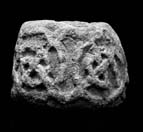
Object type: Architectural(?)
Measurements: H. 17 cm (6.75 in); Diam. 18 < 22 cm (7 < 8.5 in); Diam. (top) of central hole 8 cm (3.25 in), D. 9 cm (3.5 in); Diam. of smaller hole 2.5 cm (1 in)
Stone type: Yellowish grey (5Y 7/2), medium-grained, clast-supported, well-graded, bioclastic, oolitic limestone. The ooliths are mostly in the range 0.3 to 0.5 mm diameter. The clasts are sub-rounded to well-rounded, mostly in the above grain-size range, but a few are up to 0.9 mm across; a few platy fragments are up to 2 mm across. Portland stone, Portland Freestone Member, Portland Limestone Formation, Portland Group, Upper Jurassic
Plate numbers in printed volume: Pls. 258-66
Corpus volume reference: Vol 7 p. 159-60
(There may be more views or larger images available for this item. Click on the thumbnail image to view.)
The piece is cone-shaped with a smooth flattened base and narrower top in which there are two neatly shaped holes — the larger is approximately central and the smaller is in the 'rim'. The circumference of the stone is carved with four-strand interlace in what was once fluently carved over-and-under technique, but which is now very worn and in places rubbed or chipped away. Working around the face is a series of two conjoined and turned pattern A knots with outside strands which continue to repeat the pattern, although at one point the face of the stone has been rubbed away by reuse, perhaps connected to the two holes at the top. The pattern of two knots evidently then continued, although nearly rubbed away and there is an uncertain junction with the first mentioned pair. The smaller hole cuts diagonally through the 'rim' and emeges below as an irregular shape in the area of greatest wear. The larger is almost circular, smooth and flat at the base, but displaced from the centre of the stone by the position on the 'rim' of the smaller hole.
Although the form of this piece looks like a capital there are problems with this interpretation, as Burrow and Hinton note (1983, 41). In scale it could fit a small shaft or indeed it could have been reshaped from a round shaft on the scale of that from Winchester High Street (Tweddle et al.1995, ills. 679–82), but the taper seems too sharp if it had been reshaped from a column. In shape it more resembles a beehive quern and if this had been its original use then the small diagonal hole in the rim would be explained. It could then have been reshaped for a different use by smoothing the base and decorating the surface. Foster considered that it might have been a trial piece (Foster 1987, 66), but its decoration is confident and the pattern of interlace seems to fit the cone shape. The irregular hole at the base, in an area where the decoration is almost obliterated, could indicate a third use, but it is possible that this occurred when the piece was set against a wall. In which case it could have served as a piscina with the hole functioning as a drain. One cannot however entirely rule out the idea that this was first constructed as a capital or impost. In which case, like so many of the possible architectural features of the pre-Conquest period in western Wessex, it seems a one-off (see introduction, p. 37). The widely spaced knots of the interlace have reasonably been compared with Batcombe, Dorset (Burrows and Hinton 1983, 44; see Ill. 43), and there seems little doubt that this is pre-Conquest in date.
