Select a site alphabetically from the choices shown in the box below. Alternatively, browse sculptural examples using the Forward/Back buttons.
Chapters for this volume, along with copies of original in-text images, are available here.


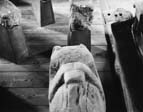
Object type: Hogback [1]
Measurements: L. 124.5 cm (49 in) W. 31.7 cm (12.5 in) H. (ends) 45.7 and 36.8 cm (18 and 14.5 in); (crown) 43.2 cm (17 in)
Stone type: As Brompton In Allertonshire 3 (St Thomas)
Plate numbers in printed volume: Ills. 100–3
Corpus volume reference: Vol 6 p. 77-78
(There may be more views or larger images available for this item. Click on the thumbnail image to view.)
Fragments of the ridge survive by the end-beasts' jowls but show no trace of decoration.
A (long) : Below the position of the ridge is a horizontal run of interlace following the arc of the hogback ridge. It tapers at the ends and is surrounded by roll moulding. The pattern is closely knit, disorganised three-cord plait. Below, the sides are plain, possibly scabbled.
The end-beasts are very stylised, their heads liveried in interlace. The damaged head is the smaller of the two. The interlace on the surface of the head is median-incised. The incised eyes are elliptical, consisting of two rings. The ears are small and pricked. The jowl has drilled nostrils and a thin mouth-slit. Instead of a muzzle, the paws are placed over the jowl. Around the wrists is a plain band and each paw has four toes. The forelegs are held vertically, rising from a neat scrolled joint. The backs are slightly rounded.
C (long) : As face A, but the interlace is damaged.
This is a type d (extended niche) hogback and its end-beasts are among the most elaborate in the series. Unlike the hogbacks nos. 17–19, this has a pair of highly stylised end-beasts, of the same proportions as their naturalistic neighbours but with creative conceits in their decoration, like the wrist-bands, livery and position of the paws. The surface interlace covering of the heads may be compared with the animal-head posts of the Oseberg ship (Wilson and Klindt-Jensen 1966, pls. XI–XII) or, nearer in date, to the treatment of the terminal heads of the Søllested horse-yokes (ibid., pl. XXXVII c). This does seem to be undiluted Scandinavian influence, as there are no Insular parallels for it. This hogback is unique in its end-beast ornamentation.
