Volume 6: Northern Yorkshire
Select a site alphabetically from the choices shown in the box below. Alternatively, browse sculptural examples using the Forward/Back buttons.
Chapters for this volume, along with copies of original in-text images, are available here.
Current Display: Brompton in Allertonshire 23, Yorkshire North Riding


Overview
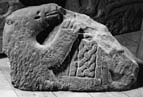
Object type: Hogback fragment [1]
Measurements: L. 70 cm (27.6 in) W. (end) 21.6 cm (8.5 in); (broken end) 25.4 cm (10 in) H. 40 cm (15.75 in)
Stone type: As Brompton In Allertonshire 3 (St Thomas)
Plate numbers in printed volume: Ills. 97–9
Corpus volume reference: Vol 6 p. 77
(There may be more views or larger images available for this item. Click on the thumbnail image to view.)
Present Location
Monks' Dormitory, Durham cathedral, catalogue no. 61
Evidence for Discovery
See Brompton In Allertonshire 4 (St Thomas)
Church Dedication
St Thomas
Present Condition
One end of a hogback. Slightly weathered on top but fairly crisp below
Description
The small stump of the ridge, with two incised lines, is all that remains by the end-beast's jowl.
A (long) : Any tegulation on the roof is lost. A single vertical panel of closed circuit interlace, neatly cut and flanked by plain moulding, survives. Above it is fragmentary cable moulding, but no moulding is carved at the panel's base.
The end-beast is three-dimensional and naturalistic. The bear-like head has incised circular eyes, and rimmed ears with rounded tips. Only the forelegs are depicted, five toes reaching to the ridge. The back is quite rounded. The tapering jowl is muzzled and the side of the tongue is carved within the jaw-slit.
C (long) : As face A, except that two panels of interlace survive.
Discussion
The design and cutting technique are identical with nos. 17 and 18; perhaps part of a composite set (see above, p. 75).
Date
First half of tenth century
References
Haverfield and Greenwell 1899, 123–4, no. LXI, fig. on 124; Collingwood 1907, 276, 300; Collingwood 1912, 123; Cramp 1965a, 8, no. 61; Lang 1967, 42–3, pl. VII; Lang 1984a, 122, no. 8, pl. on 123
Endnotes
[1]The following are general references to the Brompton stones: (—) 1867–8, lxxxviii; Rowe 1870, 240; (—) 1871–2, xxiv; Greenwell 1869–79a, lx; Rowe 1877, 61–4; Allen and Browne 1885, 352; Browne 1885–6, 124, 128; Saywell 1886, 481; Allen 1887, 126, 386, fig. 28; (—) 1890–5a, viii; Haverfield and Greenwell 1899, 125–6; Bulmer 1890, 389; Hodges 1894, 195; Morris, J. 1904, 32, 84–5, 420; Bogg 1908, 28–32, ills. on 29 and 32; Page, W. 1914, 430, 431; Morris, J. 1931, 33, 86, 87, 417; Elgee and Elgee 1933, 219–20, 245; Mee 1941, 41–2; Fisher 1959, 89; Pevsner 1966, 90, pl. 8; Bailey 1980, 85, 100, 240, 252, 255, 265; Kerr and Kerr 1982, 38–9 and ill.; Morris, R. 1983, 7; Cramp 1984, 11, 30, 93; Bailey and Cramp 1988, 54; Lang 1988a, 14, 24, 56; Cambridge 1989, 378; Richards 1991, 80, 119, 124, ill. 81; Everson and Stocker 1999, 138; Stocker 2000, 205–6.