Select a site alphabetically from the choices shown in the box below. Alternatively, browse sculptural examples using the Forward/Back buttons.
Chapters for this volume, along with copies of original in-text images, are available here.


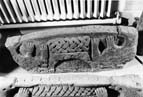
Object type: Hogback [1]
Measurements: L. 135.9 cm (53.5 in) W. (ends) 27.9 and 22.9 cm (11 and 9 in) H. (ends) 47 and 42.5 cm (18.5 and 16.7 in); (crown) 52.1 cm (20.5 in)
Stone type: As Brompton In Allertonshire 9 (St Thomas), but showing traces of having been burnt
Plate numbers in printed volume: Ills. 88, 90
Corpus volume reference: Vol 6 p. 76
(There may be more views or larger images available for this item. Click on the thumbnail image to view.)
A ridge issues from the jowls of the end-beasts, its top decorated with step-pattern 1 between plain mouldings.
A (long) : Below the ridge and between the end-beasts' paws is a horizontal strip of four-strand plain plait, clumsily cut and with no edge mouldings. It has six stages and the hole-points are deeply cut. The strand is fairly broad. Below is a recessed semicircular niche with signs of rough dressing.
The end-beasts are not muzzled, the jaws being a thin slit and the jowl square-cut. Circular eyes are incised on the top of the head. The ears are small and rounded with a rim. Each beast has fore and hind legs, the paws having four toes. Their posture assumes a reclining position with the legs upwards. The sides are much defaced with hack-marks and are steeply curved.
C (long) : Identical with face A, except that the plait is of only five stages.
This is amateurish work compared with nos. 17, 18 and 19. The crude cutting, especially of the end-beasts, and the absence of planning in the plait demonstrate that this is by a less accomplished hand, possibly the same as the sculptor of no. 22, where the lack of mouldings and the crude hatching also appear. It does, however, conform to type c (niche) in layout and may well be a copy made after the demise of the more expert atelier that produced nos. 17–19. It appears to have been carved free-hand.
