Select a site alphabetically from the choices shown in the box below. Alternatively, browse sculptural examples using the Forward/Back buttons.
Chapters for this volume, along with copies of original in-text images, are available here.


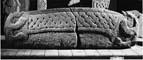
Object type: Hogback [1]
Measurements: L. 147.3 cm (58 in) W. (ends) 26.7 cm (10.5 in) H. (ends) 38.1 and 41.9 cm (15 and 16.5 in); (crown) 45.7 cm (18 in)
Stone type: Poor quality, medium-grained deltaic sandstone with mica and feldspar. The sub-angular grains in the poorly sorted fabric are partly cemented by limonite. Yellow (10YR 7/6). Stone provenance as no. 1
Plate numbers in printed volume: Ills. 92–3, 96
Corpus volume reference: Vol 6 p. 76-77
(There may be more views or larger images available for this item. Click on the thumbnail image to view.)
A ridge issues from the end-beasts' jowls, its top decorated with meander 2 T-fret between plain mouldings. There is a fault in the pattern at one point.
A (long) : Below the ridge is a long horizontal run of interlace enclosed by a plain moulding; the pattern consists of 14 stages of closed circuit, densely woven plait. The lower moulding is spread at each end into a spandrel for the extended niche with flattish top and recessed interior.
The end-beasts are smallish and have fore and hind legs. The paws have five toes which fall short of the ridge. Their posture is erect and they lack muzzles. Circular eyes are incised on the top of the head and the nostrils are drilled. The rimmed ears are slightly pointed. The heads are in bold relief.
C (long) : Identical with face A, except for the loss of the niche and the paws having only four toes.
This is a good example of the extended niche type (type d). Despite the odd slip in the fret pattern, the design is well ordered and the hole-points suggest griding. The end-beasts are coherently formed even though their scale has diminished compared with nos. 17–19. Of particular interest, this hogback is identical with one at Sockburn, no. 16 (Cramp 1984, 141, pl. 142, 759–60), demonstrating that both sites were served by a single workshop (see Chap. VI, p. 47).
