Select a site alphabetically from the choices shown in the box below. Alternatively, browse sculptural examples using the Forward/Back buttons.
Chapters for this volume, along with copies of original in-text images, are available here.


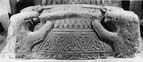
Object type: Hogback [1]
Measurements: L. 127 cm (50 in) W. (ends) 20.3 and 20.7 cm (8 and 8.1 in) H. (ends) 41.3 and 39.4 cm (16.25 and 15.5 in); (crown) 43.5 cm (17.1 in)
Stone type: As Brompton In Allertonshire 9 (St Thomas), except that this hogback has been partly burnt to a pink colour (5YR 7/4) on the ridge top and one side section.
Plate numbers in printed volume: Ills. 86–7
Corpus volume reference: Vol 6 p. 75-76
(There may be more views or larger images available for this item. Click on the thumbnail image to view.)
A plain ridge issues from the jowls of the end-beasts, worn, damaged and tapering slightly at each end.
A (long) : Below the ridge are two rows of type 1 tegulae identical in size with those of nos. 17 and 18. Below the tegulation a flat moulding surmounts a trapezoid panel divided into five triangular sections, each with a plain moulding and containing a triquetra.
The end-beasts are worn, though there are traces of an eye in a raised circle with a central depression. The small rounded ears are treated similarly. Each beast is muzzled. Only the forelegs are depicted, the five toes touching the base of the ridge. The beasts are naturalistic with rounded backs and bevelled corners. The sides of the hogback are bombé and the roof pitches steeply curved.
C (long) : As face A.
This hogback is of type a (panel) and shares many of the features of nos. 17 and 18. Its array of triangular panels with triquetra, however, is unique and accommodates well to the legs of the end-beasts. There are more signs of wear on the creatures, but their proportions, posture and muzzles suggest that the monument may have come from the same hand as nos. 17 and 18. The closely-packed plain strand of the knotwork is paralleled on some of the crosses at Brompton, for instance no. 9 (Ill. 51).
