Select a site alphabetically from the choices shown in the box below. Alternatively, browse sculptural examples using the Forward/Back buttons.
Chapters for this volume, along with copies of original in-text images, are available here.


Object type: Shaft fragment [1]
Measurements: H. 52.3 cm (20.6 in) W. 27.5 > 24.5 cm (10.8 > 9.7 in) D. 21 > 19 cm (8.3 > 7.5 in)
Stone type: Fine-grained, slightly micaceous deltaic sandstone, with sub-angular grains and well sorted fabric. Very pale brown to brownish yellow (10YR 7/3–6/6). Bedding visible parallel to main face with animals. Stone provenance as no. 1
Plate numbers in printed volume: Ills. 41–3
Corpus volume reference: Vol 6 p. 68
(There may be more views or larger images available for this item. Click on the thumbnail image to view.)
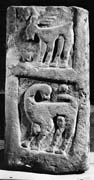
A (broad) : Possibly the lower portion of a shaft. The edge moulding is broad, bevelled at the corners, and irregular in width. A transverse moulding divides two squarish panels. (i) The upper one contains a solitary stag with branched antlers depicted by parallel diagonal incisions; its head is dipped and its legs are straight. Before it, by its feet, is a single bold pellet. (ii) The panel below has a standing quadruped with head turned over its straight back. The tail is short and held forward. Above it is a single pellet.
B (narrow) : The edge moulding is like that on face A, with a broad hacked plinth at the base. (i) The fragmentary upper panel has the termination of a Como-braid or S-twist, in fleshy strand and deep hole-points. (ii) The lower panel is long and contains five registers of four-cord plain plait which falls out of proportion at the base. The strand is modelled.
C (broad) : The broad irregular edge moulding survives only on the left. (i) The base of the upper panel contains remains of box-point terminals with three deep hole-points. (ii) Below the transverse moulding, which is damaged, is a crudely cut standing human figure, frontally posed. The head is round and flat with primitive incised features; it is surmounted by an oblong filler. The figure wears a kirtle and carries a staff in his left hand. The right hand is held across the body with spread fingers. The shoulders are raised; the legs long and vertical.
D (narrow) : Dressed.
Greenwell was right in suggesting that the figure of face C is secondary re-cutting, as the odd edge moulding confirms. The small panels with isolated animals, Como-braid and deep hole-points are all features of the Allertonshire workshop, but the irregularities in the proportions and layout show that, unlike that workshop's true products, the designs were not gridded. This is a brave copy, and may be modelled on Sockburn 7 (Cramp 1984, 138, pl. 134). The modelling of the edges is also taken from the Allertonshire group.
