Select a site alphabetically from the choices shown in the box below. Alternatively, browse sculptural examples using the Forward/Back buttons.
Chapters for this volume, along with copies of original in-text images, are available here.


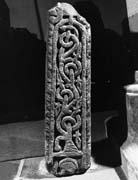
Object type: Upper part of shaft [1][2]
Measurements: H. 77.6 cm (30.5 in) W. 29.3 > 25.2 cm (11.5 > 10 in) D. 21 > 18.6 cm (8.25 > 7.3 in)
Stone type: Medium to coarse-grained, slightly feldspathic sandstone with a soft limonitic cement. Sub-angular grains in a well-sorted fabric. Brownish yellow (10YR 6/6). Stone provenance as no. 1. (This stone was also used in Northallerton 2 and 8, p. 181.)
Plate numbers in printed volume: Ills. 37–40
Corpus volume reference: Vol 6 p. 66-67
(There may be more views or larger images available for this item. Click on the thumbnail image to view.)
A (broad) : The edge moulding is a grooved cable locked by a ring at the top corner to the plain transverse moulding. The upper part of the shaft is occupied by a frontally disposed male figure with a pear-shaped face and short hair, framed in what may be curtains. His hands are crossed at the centre of his body but only the left hand survives clearly. He holds a rectangular object which could be a book or a maniple, and low across his shoulders is a horizontal band from which are suspended two large wing-like features. The lower part of the shaft is scabbled.
B (narrow) : The outer edge moulding is a grooved cable with locking ring to the plain transverse moulding at the top. Within it is a plain internal moulding, curved at the top and with a plain transverse element separating two panels. The inner moulding is slightly modelled. (i) The upper panel has a plant-scroll growing from a ribbed triangular 'root'. The main stem describes an S-formation, and sprouting from three nodes are heavy side shoots which knot and terminate in pointed and lobed leaves with incised centres. (ii) The lower panel retains the crested helmet and spear-head of a warrior.
C (broad) : An outer grooved cable edge moulding is locked by a ring to a plain transverse moulding. Within, a plain moulding separates the shaft into three panels. (i–ii) The upper two panels contain identical birds in profile. The birds have pear-shaped bodies and naturalistic rounded heads with well modelled beaks and lightly incised eyes. Their wings are defined with diagonal lines and the tip of the other wing is suggested by a curling feather above the tail. Their small flexed legs have two claws and perch on the plain transverse moulding. (iii) The broken lowest panel contains two monstrous creatures, viewed from above. They have long rounded snouts decorated with incised chevrons and incised bulbous eyes. Their thick bodies and back limbs are interlaced. They have flailing front limbs with three toes on hoof-like feet, and these cross so that each creature touches its partner's head with one hoof, whilst the other is flexed down beside the body with the foot turned inwards.
D (narrow) : A grooved cable edge moulding runs up both sides of the shaft. Within this, a plain edge moulding separates the shaft into three panels and terminates in a transverse line. (i) Above this line a broken panel contains a bird. The body is rounded and rests on top of the plain moulding. The wing is sharply everted diagonally across the panel and a fan-like tail rests against the cabled moulding to the left. The head is missing. Within the two lower panels both figures are enclosed by rounded arches inside the rectangular frames. (ii) The upper is a frontally-disposed cleric with an oval face. A thick band of hair or a halo runs from ear to ear. The features are incised and he has prominent eyes and a small slit for a mouth. His arms are flexed across the body and he grasps a book in both hands. He wears a long robe that conceals his lower limbs. (iii) The bottom panel is very damaged, but the worn head and shoulders of what may be another cleric remain. The figure is frontal, the face more wedge-shaped, and the features are lightly conveyed. The hair is short and may be tonsured. His neck and shoulders appear to be bare, and the tops of two triangular wing-like objects jut diagonally across his shoulders to the edge of the panel.
This is a very technically accomplished piece of carving, produced by the Allertonshire workshop (Chapter VI). Most panels show evidence of gridding, and Bailey has demonstrated the use of templates in the construction of the decoration (1978b, 184–5). The pot-bellied birds of face C can also be seen on Kirklevington 3 (Ill. 408), and are derived from the same template that was used to construct the helmets of the warriors seen on Brompton 3, Kirklevington 3, and Sockburn 5, co. Durham (Ills. 38, 408, 1189). The form of the resulting bird is rigidly controlled by the use of this half-moon template: its puny legs seem hardly able to support an unnaturally huge body (Bailey 1978b, 184–5). These birds are unlikely to be the chickens that they resemble but may be peacocks, symbolising eternity, or doves. The more graceful bird on face D has better claim to this identification. The pair of joined dragons seen from above on face C have an earlier parallel in the entwined monsters seen from above on Melsonby 1 (Ill. 655), only a few miles distant. The Melsonby animals are more graceful, but the similarity in the positioning of the beasts, their flailing limbs and entwined bodies suggests that Brompton 3 is an Anglo-Scandinavian copy. The Brompton sculptor has also borrowed a convincing Anglian plant-scroll, retaining its traditional characteristics in the manner of a carving of similar date from Hart, co. Durham (Cramp 1984, pl. 79, 395). The frontally disposed clerics set with arched panels are, again, reminiscent of Anglian forms of figure carving, for example the heavy block-like figures at Collingham in the West Riding (Collingwood 1915, 156), and the facial types of the upper figures on faces A and D are very closely paralleled at Melsonby (Ill. 657). The warrior of face B, however, indicates that the sculptor was fully aware of Anglo-Scandinavian conventions and forms in sculpture. There is no doubt about the clerical attributes of the upper figure on face D, but whether he is supposed to represent a specific figure is less clear. He could be a local saint such as St Cuthbert, or could represent the priesthood in general. The upper figure on face A and the lower figure on D might be angels, although their wings are attached like those on Weland's 'flying machine' (Lang 1976, fig. 7).
The combination of birds and reptilian beasts reflects a tradition in which birds are images of good, as the symbol of St John and even of the risen Christ, whilst reptiles are creatures of evil and hell, as for example on the Rothbury cross, Northumberland (Cramp 1984, pl. 215, 1224). Certainly this seems to be a piece which is truly 'transitional' between the old Anglian patterns of belief and their representation, and the new images of the Viking Age, and something of the opposition of two forces is reflected in its iconography.v
[1]The following are general references to the Brompton stones: (—) 1867–8, lxxxviii; Rowe 1870, 240; (—) 1871–2, xxiv; Greenwell 1869–79a, lx; Rowe 1877, 61–4; Allen and Browne 1885, 352; Browne 1885–6, 124, 128; Saywell 1886, 481; Allen 1887, 126, 386, fig. 28; (—) 1890–5a, viii; Haverfield and Greenwell 1899, 125–6; Bulmer 1890, 389; Hodges 1894, 195; Morris, J. 1904, 32, 84–5, 420; Bogg 1908, 28–32, ills. on 29 and 32; Page, W. 1914, 430, 431; Morris, J. 1931, 33, 86, 87, 417; Elgee and Elgee 1933, 219–20, 245; Mee 1941, 41–2; Fisher 1959, 89; Pevsner 1966, 90, pl. 8; Bailey 1980, 85, 100, 240, 252, 255, 265; Kerr and Kerr 1982, 38–9 and ill.; Morris, R. 1983, 7; Cramp 1984, 11, 30, 93; Bailey and Cramp 1988, 54; Lang 1988a, 14, 24, 56; Cambridge 1989, 378; Richards 1991, 80, 119, 124, ill. 81; Everson and Stocker 1999, 138; Stocker 2000, 205–6.
[2]The following are unpublished manuscript references to no. 3: BL Add. MS 37552 no. XIV, items 506–7; BL Add. MS 37554 no. XVI, items 1
