Select a site alphabetically from the choices shown in the box below. Alternatively, browse sculptural examples using the Forward/Back buttons.
Chapters for this volume, along with copies of original in-text images, are available here.


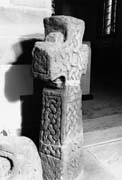
Object type: Incomplete cross [1][2]
Measurements: H. 107.3 cm (42.2 in) W. 30 > 22.2 cm (11.8 > 8.8 in) D. 21 > 17.2 cm (8.3 > 6.8 in)
Stone type: See Brompton In Allertonshire 1 (St Thomas)
Plate numbers in printed volume: Ills. 33–5
Corpus volume reference: Vol 6 p. 65-66
(There may be more views or larger images available for this item. Click on the thumbnail image to view.)
A (broad) : The cross is a plate-head (type 5) with type 10 arms, the upper limb with a curved tip. There is a broad, rough perimeter moulding. Each arm contains a 'Brompton loop' linked to the adjacent one. In the centre is a rectangular element containing an incised rectangle with a saltire. All the work is picked. There are possible traces of red pigment on the surface. The neck of the shaft is marked by a plain transverse moulding. Below is a panel of closely woven six-cord plain plait in a closed circuit of five stages. The broad edge moulding is roughly carved. The lower part of the decoration is terminated in a vandyke, damaged at its tip, within a plain moulding but with no internal divisions. It contains three interlace patterns of closed circuit, the lowest one damaged at the base: the upper part of the two surviving knots resembles the 'Brompton loop', but with a bar terminal below.
B (narrow) : The arm-tip has a roughly cut Stafford knot (pattern E), off-centre. Below is a plain edge moulding flanking roughly carved four-cord plain plait, with a pair of concentric pattern F loops resolving the base of the design. The carving is picked work. The lower part of the face is undecorated.
C (broad) : The cross-head has a plain perimeter moulding, each arm filled by a 'Brompton loop' with occasional pellet fillers. There is some evidence of median-incised strand. In the centre is a clumsy Stafford knot/triquetra. Below is a panel of four-cord plain plait, resolved at the base with two concentric pattern F loops. The pattern is open and in slightly modelled strand. The lower part is undecorated.
D (narrow) : The arm-tip has an incised perimeter moulding. Below, within a plain edge moulding, is four-cord plain plait, resolved at the top with a pair of concentric loops, the upper one flattened into a bar terminal. The base is uncarved.
The crosses nos. 1 and 2 are by the same hand. They share a unit of measure of one imperial inch but the cutting is often rough. Both crosses have a trick of varying the resolution of four-cord plain plait by a pair of concentric loops, always at one end only; it appears to be a deliberate device but conveys a clumsy appearance by breaking the symmetry. The smaller closed circuit knots, within the vandykes for example, are hybrid forms between a triquetra and a Stafford knot, which flatten a loop against a horizontal edge.
The vandykes, or shield-shaped panels at the base of the decoration, are ornamental skeuomorphs of the metal appliqués used to strengthen the mid-point of wooden poles, for example on the Kells crozier (Lang 1986a, 246–8, fig. 1; Mac Dermott 1955, pls. XXXII–IV). The feature occurs elsewhere in the North Riding, though from different workshops: on Gilling West 1 and Stanwick 2 (Ills. 262–5, 760–3), near to Brompton, and Lastingham 1 in Ryedale, which has a twin in Sherburn 4 in the East Riding (Lang 1991, 167, 203–4, ills. 574–7, 772–5). The vandyke is evidence for putative wooden crosses with metal appliqués, of which the stone versions are echoes. The plain lower portions are parallelled at Sockburn (Cramp 1984, nos. 4 and 8, 137–9, pls. 129, 706–9 and 135, 730–2) and may have accommodated adjacent hogbacks. The 'Brompton loops' (Fig. 12, p. 47) of the cross-arms seem to have been copied from the more accomplished cross-heads, nos. 11 and 12 (Ills. 58–61, 62–5), which Bailey has demonstrated came from a single template (Bailey 1978b, 183, fig. 9 and 10).
[1]The following are general references to the Brompton stones: (—) 1867–8, lxxxviii; Rowe 1870, 240; (—) 1871–2, xxiv; Greenwell 1869–79a, lx; Rowe 1877, 61–4; Allen and Browne 1885, 352; Browne 1885–6, 124, 128; Saywell 1886, 481; Allen 1887, 126, 386, fig. 28; (—) 1890–5a, viii; Haverfield and Greenwell 1899, 125–6; Bulmer 1890, 389; Hodges 1894, 195; Morris, J. 1904, 32, 84–5, 420; Bogg 1908, 28–32, ills. on 29 and 32; Page, W. 1914, 430, 431; Morris, J. 1931, 33, 86, 87, 417; Elgee and Elgee 1933, 219–20, 245; Mee 1941, 41–2; Fisher 1959, 89; Pevsner 1966, 90, pl. 8; Bailey 1980, 85, 100, 240, 252, 255, 265; Kerr and Kerr 1982, 38–9 and ill.; Morris, R. 1983, 7; Cramp 1984, 11, 30, 93; Bailey and Cramp 1988, 54; Lang 1988a, 14, 24, 56; Cambridge 1989, 378; Richards 1991, 80, 119, 124, ill. 81; Everson and Stocker 1999, 138; Stocker 2000, 205–6.
[2] The following is an unpublished manuscript reference to no. 2: BL Add. MS 37552 no. XIV, items 500, 503 (Romilly Allen collection).
