Select a site alphabetically from the choices shown in the box below. Alternatively, browse sculptural examples using the Forward/Back buttons.
Chapters for this volume, along with copies of original in-text images, are available here.


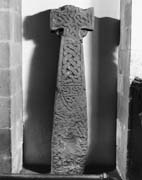
Object type: Incomplete cross [1][2]
Measurements: H. 155.6 cm (61.3 in) W. 32 > 19 cm (12.6 > 7.5 in) D. 24.8 > 16.4 cm (9.75 > 6.5 in)
Stone type: Medium-grained, slightly feldspathic sandstone, with sub-angular grains. Very pale brown (10YR 7/3). Deltaic sandstone from the Saltwick Formation, Aalenian, Middle Jurassic. Stone of this type has been quarried from the top of the Harlsey–Knayton Ridge to the east of Brompton and also on the lower escarpment of the Hambleton Hills, even further to the east of Brompton.
Plate numbers in printed volume: Ills. 30–2
Corpus volume reference: Vol 6 p. 65
(There may be more views or larger images available for this item. Click on the thumbnail image to view.)
A (broad) : The cross-head, type B8/9, is 38.5 cm across and has a plate (type 5). The disc is plain and recessed. The cross-arms have a plain perimeter moulding, with irregular pattern F 'Brompton loops' (Fig. 12, p. 47) in each arm, connected by a continuous flat strand. The approximate centre of the cross-head is marked by a roughly carved pellet; the neck is defined by a transverse plain moulding. Below is a panel of four-cord plain plait in broad flat strand, roughly cut and tapering upwards. Beneath this is another transverse moulding. The lower termination of the carving is a shield-shaped vandyke with a plain edge moulding and divided into three sectors by a horizontal moulding and a short vertical moulding of narrow proportions. The two upper sectors each contain a triquetra with a flattened lower loop to fill the square panel. In the lowest sector is a triquetra in flat strand. Beneath this, the lower 62 cm of the shaft is undecorated. The uncarved lower portion is scabbled and tapered at the base for a socket.
B (narrow) : The tip of the cross-arm has a rough broad frame which contains a bold triquetra with a pellet in the lower right-hand corner. On the shaft below, within a plain edge moulding and frame, is a panel of interlace in broad flat strand tapering upwards: at the top it is four-cord plain plait but the lower end is resolved in a pair of concentric pattern F loops. The lower 77.5 cm of the shaft is undecorated.
C (broad) : Not visible, but carved.
D (narrow) : As face B, but with a bar terminal below, and the panel has a transverse moulding at the top. The arm-tip has a shrunken version of the interlace pattern on the sides of the shaft.
See Brompton In Allertonshire 2 (St Thomas)
[1]The following are general references to the Brompton stones: (—) 1867–8, lxxxviii; Rowe 1870, 240; (—) 1871–2, xxiv; Greenwell 1869–79a, lx; Rowe 1877, 61–4; Allen and Browne 1885, 352; Browne 1885–6, 124, 128; Saywell 1886, 481; Allen 1887, 126, 386, fig. 28; (—) 1890–5a, viii; Haverfield and Greenwell 1899, 125–6; Bulmer 1890, 389; Hodges 1894, 195; Morris, J. 1904, 32, 84–5, 420; Bogg 1908, 28–32, ills. on 29 and 32; Page, W. 1914, 430, 431; Morris, J. 1931, 33, 86, 87, 417; Elgee and Elgee 1933, 219–20, 245; Mee 1941, 41–2; Fisher 1959, 89; Pevsner 1966, 90, pl. 8; Bailey 1980, 85, 100, 240, 252, 255, 265; Kerr and Kerr 1982, 38–9 and ill.; Morris, R. 1983, 7; Cramp 1984, 11, 30, 93; Bailey and Cramp 1988, 54; Lang 1988a, 14, 24, 56; Cambridge 1989, 378; Richards 1991, 80, 119, 124, ill. 81; Everson and Stocker 1999, 138; Stocker 2000, 205–6.
[2]The following is an unpublished manuscript reference to no. 1: BL Add. MS 37552 no. XIV, item 504 (Romilly Allen collection).
