Select a site alphabetically from the choices shown in the box below. Alternatively, browse sculptural examples using the Forward/Back buttons.
Chapters for this volume, along with copies of original in-text images, are available here.


Object type: Shaft fragment [1]
Measurements: H. 60.3 cm (24.8 in) W. 25.4 cm (10 in) D. 27 > 23.5 cm (10.6 > 9.2 in)
Stone type: As Brompton In Allertonshire 3 (St Thomas)
Plate numbers in printed volume: Ills. 44–7
Corpus volume reference: Vol 6 p. 69
(There may be more views or larger images available for this item. Click on the thumbnail image to view.)
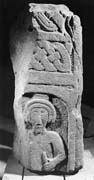
A (broad) : The left-hand edge is lost. The edge mouldings are flat and have transverse elements dividing three panels. (i) The topmost panel has remains of interlace in flat double-outlined strand. (ii) The middle panel is wider than it is high, and contains a horizontal run of illogical interlace, neatly cut in a flat strand, with a free end and hidden terminations. It is densely woven. (iii) The lowest panel is longer and contains an inner arched moulding forming a niche. Within it is a frontally disposed human figure with pointed chin and modelled facial features, and two mouldings serve as a close-fitting double nimbus. Above this is an oblong filler. The figure's torso and left arm are cut in high relief and well modelled. The hand, with well cut fingers, holds the tip of a staff. The rest of the figure is lost.
B (narrow) : The edge mouldings are like those on face A. There are remains of three panels. (i) The topmost is long and contains one complete register of a ring-knot linked by gliding strands to a very damaged one above it. The knot's pattern consists of two linked oval rings, threaded by two strands in saltire that terminate in the lower corners. (ii) The middle panel has a profile bird, stepping to the left with half-raised wing. Its head is crow-like. (iii) The lowest panel is largely destroyed but has a little median-incised strand.
C (broad) : The mouldings are as on face A. (i) The topmost panel contains a damaged ring-knot of closed circuit pattern B. (ii) The middle panel has two linked oval rings threaded by two strands in saltire. (iii) The lowest panel has the upper part of an animal with stumpy tail and backward turned head. The jaws have small fangs. The very small ears are pricked and the circular eye is incised.
D (narrow): Broken away except for one portion of edge moulding.
The figure of face A may be the model for the secondary figure of Brompton 4C (Ill. 43). This is more accomplished carving, though it is free-hand, ungridded work. The figure portrait, choice of bird and animal, and tight interlace are all features of the Brompton school (see Chap. VI, p. 47), but this piece is not from the Allertonshire workshop. The modelling of the figure is, however, a reflex of that atelier.
