Select a site alphabetically from the choices shown in the box below. Alternatively, browse sculptural examples using the Forward/Back buttons.
Chapters for this volume, along with copies of original in-text images, are available here.


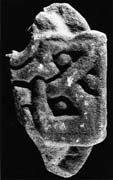
Object type: Fragment of cross-head
Measurements: H. 17 cm (6.75 in); W. 29 cm (11.5 in); D. 14.3 cm (5.5 in)
Stone type: Coarse-grained, non-micaceous, very pale brown (10YR 7/4) sandstone; see no. 2.
Plate numbers in printed volume: 639-643
Corpus volume reference: Vol 3 p. 177
(There may be more views or larger images available for this item. Click on the thumbnail image to view.)
Cross-arm, type A11, with ring, type 1(a). The outer part of the ring is recessed from the faces of the cross, and is decorated on its outer edge with step pattern 1 between plain mouldings, and on the sides with incised zig-zag.
A (broad): The cross-arm is of type A11, expanded into a rectangular panel, and contained by a narrow roll moulding. Within a modelled strand forms a type of angular Stafford Knot, the spaces filled by large single pellets.
B (narrow): The flat end of the arm has a rectangular panel contained by roll moulding of narrow dimensions. Within is a plain rectangular strip surrounded by strands two of which lie parallel at each end and form irregular interlace along the sides.
C (broad): As A, but worn. The expanded rectangular panel at the end of the arm is apparently filled with plain plait.
D (narrow): Broken off.
The cross-head is of a local type. The crest to the wheel rarely occurs outside this part of Ryedale. It occurs on the Middleton and Kirkbymoorside crosses in two forms, and from the cutting techniques it is possible to distinguish the individual hand of the sculptor. The Levisham piece was cut by the carver of Middleton 2 (Ills. 676, 678–9), and Kirkbymoorside 4 (Ills. 526–30), the three heads sharing the cutting in embellishment of the ring rim. This cross-head seems to be the only piece from the site which relates directly to a nearby atelier (see Chap. 8).
