Select a site alphabetically from the choices shown in the box below. Alternatively, browse sculptural examples using the Forward/Back buttons.
Chapters for this volume, along with copies of original in-text images, are available here.


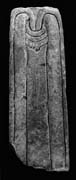
Object type: Part of cross-shaft
Measurements: H. 72.3 cm (28.5 in); W. 25.2 > 21.4 cm (10 > 8.4 in); D. 13.2 cm (5.2 in)
Stone type: Medium- to coarse-grained, non-calcareous, very pale brown (10YR 7/3) sandstone; see no. 2.
Plate numbers in printed volume: 644-647
Corpus volume reference: Vol 3 p. 176-177
(There may be more views or larger images available for this item. Click on the thumbnail image to view.)
When dampened, the roughly picked, incised grooves of the carving show faint traces of red pigment.
A (broad): A plain, flat edge moulding arches inwards from each side at the top of the shaft to meet in the centre and then descend into three horizontal upward-curving mouldings which rest on a very broad, plain central band which tapers inwards towards the top. Immediately below the horizontal elements is a half-moon shaped chip and flanking fronds which may well be the result of later damage. The areas between the central band and the outer mouldings are plain.
B (narrow): A plain, flat moulding runs up each edge. At the top, fitting snugly between the mouldings, is an incised circle; there is no other decoration. (This face was the one exposed when the stone was built into a wall.)
C (broad): Identical with face A, though less chipped. There are traces of what may be a further moulding in the spandrel between the arched heads of the two panels, which are undecorated.
D (narrow): An outer flat edge moulding flanks a narrower inner moulding which forms a semicircular arched head at the top. The panel thus enclosed is undecorated.
This piece differs in its austere decoration from the rest of the Levisham sculpture, a character which renders stylistic dating difficult. Its fracture at the top suggests either a former cross-head or a slimmer extension of the shaft, a smaller version of Kirby Misperton 1 (Ill. 508) (Brøndsted 1924, 198, fig. 145). In Lancashire this type of shouldered shaft is usually attributed to the eleventh century, for instance at Whalley, but the decorative scheme of the only two Ryedale parallels, at Kirby Misperton and Hovingham, suggests a ninth-century date for the Yorkshire examples. The closest analogue for this piece is Hovingham 3; the present stone lacks the ornamental infill but the panels and size are comparable.
A unique feature is the horizontal binding at the top of the broad faces which give an impression of a rough Borre style return loop, if such bound loops are deemed to be diagnostically Borre. Metalwork from York in this style is well known and may have provided a model. This would represent a transition between Anglian form and Scandinavian ornament. The distinctive form relating the piece to Kirby Misperton 1 and Hovingham 3, despite the possible Scandinavian hint, point to the earlier end of the proposed spectrum of dating.
