Select a site alphabetically from the choices shown in the box below. Alternatively, browse sculptural examples using the Forward/Back buttons.
Chapters for this volume, along with copies of original in-text images, are available here.


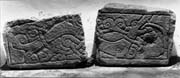
Object type: Grave-cover, in two nearly adjacent pieces
Measurements: a: L. 61.6 cm (21.25 in); W. 42.3 < 45.7 cm (16.6 < 18 in); D. 19 cm (7.5 in); b: L. 62.5 cm (24.6 in); W. 41.5 > 35.7 cm (16.3 > 14 in); D. 14.5 cm (5.7 in)
Stone type: Medium-grained, yellow (10YR 7/6) sandstone, with Ptychichnus trace fossils; see no. 2.
Plate numbers in printed volume: 648-658
Corpus volume reference: Vol 3 p. 177-178
(There may be more views or larger images available for this item. Click on the thumbnail image to view.)
Only the upper face is carved with a single panel framed by a very broad, plain, flat perimeter moulding. A solitary undulating profile beast occupies the entire panel, its head on fragment a. The ribbon body has a double outline and its width expands slightly at the bends. The head is raised, the jaws agape, and with horizontal slits from which a fang protrudes. An incised circular eye is placed in a domed brow, behind which an extended ear, median-incised, loops about the neck to end in a small volute. There are no legs but a pair of spirals erupt from the chest. A similar pair of spiral scrolls erupt from the crest of the rump's contouring, and a larger pair form the tail which has a half-moon incision on the end of each scroll.
The beast is fettered by a number of loose trailing elements of varying width. One of these, by the tail, is a short semicircular band with scrolled ends which meet the tail spirals. An oval ring appears to have looped the centre of the beast but it is obscured by the fracture. Below the rump is a large scroll terminal to a band which lies adjacent to the beast. The largest fetter is a snake whose head with protruding eyes lies behind the rump, and whose tail is bitten by the beast's fangs. The snake's body has an offshoot scroll at the base of the panel and, above the snake's tail, passes under a ham-like element beneath the beast's jaw. Here and there are isolated pellets acting as fillers.
Some of the scrolls have a transverse bar across their necks, notably the 'fore legs' and the semicircular element by the tail, though this feature may be worn away elsewhere on the stone.
This is a much discussed monument, though too often it has been taken out of its local context in order to place it in all too neat a typological progression (Brøndsted 1924, 227; Collingwood 1927, 129). The animal ornament has been variously described as developed Jellinge (Rice 1952, 126; Clapham 1930, 132) and Mammen (Wilson and Klindt-Jensen 1966, 123; Bailey 1980, 57), implying a date in the second half of the tenth century. The location of Levisham does make it unlikely that its sculptors enjoyed an immediate receptiveness to Scandinavian fashions. Comparison with neighbouring animal ornament demonstrates the parochial nature of the Levisham beast; indeed, the recently discovered shafts 1–2 refine its context to an atelier within the confines of the site. Recumbent, flat covers are known from an early date in Ryedale: two fine Anglian examples lie at Kirkdale (nos. 7–8), though they eschew zoomorphic ornament. That feature must derive from the York Metropolitan School, whose slabs under York Minster were produced at the beginning of the Anglo-Scandinavian period. The length of the slab suggests that it was once attended by end-stones, or even crosses. Its solitary animal panel is typical of Ryedale cross-shafts, for example, Middleton 1–2 (Ills. 674, 680), and the peculiar treatment of the jaws is related to others at Sinnington (no. 4; Ill. 807) and Kirkbymoorside (no. 1; Ill. 516). There are distinctive differences, however, from the Middleton animals. Its stance undulates in regular zig-zag waves, unlike the S-formation at Middleton. The head is held high instead of falling back over the body. There are no limbs, and the tail is scrolled rather than extended. These differences are not necessarily a chronological stylistic development; they are rather the marks of the idiosyncracy of local workshops. The scrolls are also a local feature and are not necessarily Mammen. They are certainly not 'proto-Ringerike', though the combat motif of large beast and filiform serpent is there. The scrolls may reflect the Newgate shaft at York (Ill. 346), and the serpent may derive from the ubiquitous fettering by body extensions found throughout this area.
