Select a site alphabetically from the choices shown in the box below. Alternatively, browse sculptural examples using the Forward/Back buttons.
Chapters for this volume, along with copies of original in-text images, are available here.


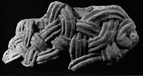
Object type: Fragment, possibly architectural or part of font
Measurements: H. 11.5 cm (4.5 in); W. 27 cm (10.6 in); D. 10.8 cm (4.25 in)
Stone type: Fine-grained yellow sandstone (Carboniferous?)
Plate numbers in printed volume: 616 - 18
Corpus volume reference: Vol 2 p. 164
(There may be more views or larger images available for this item. Click on the thumbnail image to view.)
The decorated face is curved in both planes and carries a deeply cut interlace whose strands are formed by three parallel strands, cut in modelled technique; the central strand is raised above the others.
Appendix A item (stones dating from Saxo-Norman overlap period or of uncertain date).
Interlace strands with a double incised line are a feature of the Beckermet school of carving in the Viking period (Introduction, pp. 38–40). This finely carved piece might therefore be seen as a possible inspirational source for the group. It is, however, more likely to be a post-Conquest sculpture for it is in that period that we find good parallels for the raised rib at the centre of the strand (Zarnecki 1951, pls. 35, 79; idem 1953a, pls. 34, 99). The shape of the surviving fragment would be very appropriate for the rim of a font and twelfth-century sculptures provide many examples of this type of interlace and plain plait set around font rims (Zarnecki 1953a, pls. 34–5).
