Select a site alphabetically from the choices shown in the box below. Alternatively, browse sculptural examples using the Forward/Back buttons.
Chapters for this volume, along with copies of original in-text images, are available here.


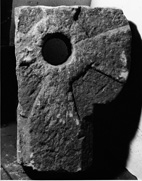
Object type: Part of grave-marker
Measurements: H. 45.75 cm (18 in); W. 30.5 cm (12 in); D. 10 cm (4 in)
Stone type: Medium-grained, pale grey sandstone (Carboniferous sandstone)
Plate numbers in printed volume: 624–7
Corpus volume reference: Vol 2 p. 165
(There may be more views or larger images available for this item. Click on the thumbnail image to view.)
A and C (broad): A cross with arm type B10 attached to a central ring is carved in low relief on a round-headed block which tapers to form a 'stem' with wide chamfered edges. The lower vertical arm joins the raised section of the stem without a break. The centre of the cross is pierced right through the stone.
B (narrow): The edge is chamfered and smoothly dressed but uncarved.
D (narrow): Broken and cut away.
Appendix A item (stones dating from Saxo-Norman overlap period or of uncertain date).
This monument belongs to a well known northern type of which there are a significant number east of the Pennines: see in particular Chollerton 2 (Cramp 1984, pl. 234, 1331), Warden 5 (ibid., pl. 255, 1391–3) and Woodhorn 4 (ibid., pl. 258, 1404–5), all in Northumberland, which have been dated to the late eleventh century. This date is supported by the reuse of a similar stone from Newcastle upon Tyne which also had a hole cut through it. This hole had been plugged when the stone was reused in a cemetery in a position which stratigraphically could not have been later than 1178 (ibid., 244–5). This date accords well with Butler's assessment that the Cleator stone '. . . must date from the early years of Norman rule . . .' (Butler 1958, 215).
Butler 1958, 215, fig. 2(a); Cramp 1984, 240
==R.J.C.
