Select a site alphabetically from the choices shown in the box below. Alternatively, browse sculptural examples using the Forward/Back buttons.
Chapters for this volume, along with copies of original in-text images, are available here.


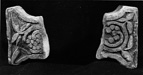
Object type: Part of cross-head, in two pieces
Measurements:
Fragment a: H. 23.5 cm (9.25 in); W. 14 cm (5.5 in); D. 12 cm (4.75 in)
Fragment b: H. 24.5 cm (9.75 in); W. 14 cm (5.5 in); D. 14 cm (5.5 in)
Stone type: Medium-grained red sandstone (St Bees sandstone)
Plate numbers in printed volume: 207 - 10, 212 - 13
Corpus volume reference: Vol 2 p. 86-87
(There may be more views or larger images available for this item. Click on the thumbnail image to view.)
The arm terminals, which are type A3, are edged by flat-band mouldings.
A (broad): On each arm are two rounded berry bunches enclosed by a volute from which sprout three pointed leaves at the top and two pointed leaves at the bottom.
B (narrow): A 'cat's cradle' motif terminating at each end in three points.
C (broad): A steeply raised 'spine' is surrounded by rather disorganized chevrons. (This face is very worn.)
D (narrow): A similar 'cat's cradle' device to that of B but less worn.
Collingwood compared the ornament on face C, in which the chevrons are surrounded by what he called a 'spine and boss' or 'lorgnette' motif, with a group of others, the finest of which are at Northallerton, Yorkshire, and Heysham, Lancashire (Collingwood 1927a, 94–6, figs. 116, 128). This motif probably derives from wooden prototypes although there are some similarities to metal forms such as on the Ormside bowl (Brown 1921, pl. 30). The 'lorgnette' feature occurs in an early incised form as far away as Lindisfarne, Northumberland, and the distinctive chevrons also occur east of the Pennines at Jarrow, co. Durham (Cramp 1984, pl. 93, 497, 499, 500) and on a newly discovered piece from Hexham, Northumberland (Introduction, n. 0). Chevrons also occur at Northallerton and Ripon, Yorkshire and in the west at Hornby, Lancashire (Collingwood 1927a, fig. 71). Collingwood's supposition that this type of delicate metallic cutting originated at Ripon does not have a very firm basis save the attested historical fact that Ripon was an important centre in West Yorkshire whose dependent lands extended to the Ribble; however, the 'Roman looking' pillar, probably for an altar, which survives in Ripon Cathedral lends art-historical support for the idea (Cramp 1974, pl. XXIIIa). The motif of the lorgnette or spine and boss (Fig. 7) remains popular throughout the Anglian and into the Viking age in Cumbria. It features on the heads of the two Penrith crosses (nos. 4 and 5) from the Giant's grave and is a hallmark of the spiral-scroll school (see Introduction, pp. 33–8). The well shaped berry bunches and the delicate pointed leaves on face A can also be paralleled at Northallerton, but again there seem to be common fashions east and west of the Pennines: Heversham 1 has the remains of a cross-shaft ornamented with a berried scroll, and on face C the delicate triple pointed leaves are very similar to these at Carlisle. Finally, the strange 'cat's cradle' motif finds a close parallel at Lancaster (Collingwood 1927a, fig. 128). Links between Lancaster, Carlisle, and North Yorkshire, have been mentioned in the Introduction (p. 13), and this cross well illustrates an identity of style in the regions of Cumbria and Deira.
