Select a site alphabetically from the choices shown in the box below. Alternatively, browse sculptural examples using the Forward/Back buttons.
Chapters for this volume, along with copies of original in-text images, are available here.


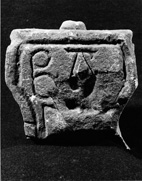
Object type: Cross-arm
Measurements: H. 17.2 cm (6.75 in); W. 14.3 cm (5.57 in); D. 8.6 cm (3.25 in)
Stone type: Medium-grained yellow sandstone (Carboniferous?)
Plate numbers in printed volume: 202 - 6
Corpus volume reference: Vol 2 p. 85-86
(There may be more views or larger images available for this item. Click on the thumbnail image to view.)
The arm, type A10, is outlined by a single roll moulding.
A (broad): Part of an inscription, in Anglo-Saxon capitals:
BA
[..]
The B appears to have been cut or recut with a different tool. The rest of the surface has been obliterated.
B (narrow): On the upper panel, surrounded by a fine roll moulding is a small bush scroll. Each coil terminates in a round berry. The arm-pit is smoothly dressed.
C (broad): Part of a heart-shaped medallion-scroll in which the strands cross in the top centre and terminate in two curving, pointed leaves, with two flanking buds or berries with detached lobes on the stems. The surface is smoothly dressed and the leaf shapes and the strands are outlined by a small punch.
D (narrow): A panel with a small bush scroll, slightly asymmetrical, and with fine horizontal tooling on the arm-pit.
E (top): Smoothly dressed, with a small flat-topped boss in the centre.
The little boss on the top of this cross-arm may be a pointer to the origin of this form of cross, since it could be derived from the hanging device of a metalwork cross, and its delicate, miniature ornament would support that view. On the other hand, very large knob-like cappings occur on some of the cross-heads of Ossory, in Ireland (Henry 1965, pl. 75), and there is a similar knob on the crucifix from Kirkburton, Yorkshire (Collingwood 1927a, fig. 125). The Carlisle head could be earlier than any of these examples, but it is worth remembering that the Ossory crosses have been widely compared with metalwork prototypes, and the Kirkburton stone could be imitating a metal crucifix. The positioning of the inscription – most probably a personal name – parallels that on no. 1, and the lettering is similarly of the manuscript type of display capitals. Bailey notes that the combination of inscription and plant-scroll on a cross-head can be paralleled at Dewsbury, Yorkshire (Bailey 1974a, I, 38). In its details and organization, the graceful medallion plant terminal is unique. The curving, pointed leaf and heart-shaped joint at the stem, and paired 'berries' on either side of the stem above is, in stone sculpture, closely paralleled at Croft, Yorkshire (Collingwood 1927a, 47, fig. 59) and on Lowther 1. The leaves with detached lobes or berries also occur in Pictish sculpture (Henderson 1983, figs. 104–5). But this type of scroll is more closely paralleled in manuscripts such as the Leningrad Gospels (fol. 3v.; Alexander 1978, ill. 83). The tiny bush-scrolls on B and D are also comparable with some found in the bases of the canon table arcades in the Leningrad Gospels (fol. 12v.; ibid., 1978, ill. 188), and the bush-scroll motif is popular in southern English sculpture of the eighth and ninth centuries (Tweddle 1983, 20–2). In this area, such scrolls occur on Penrith 1, face A. They are nearly identical, however, in scale as well as design, to the small scrolls on the edges of the centre of an unpublished cross-head discovered in 1983 at Norham, Northumberland (Ill. 675).
