Select a site alphabetically from the choices shown in the box below. Alternatively, browse sculptural examples using the Forward/Back buttons.
Chapters for this volume, along with copies of original in-text images, are available here.


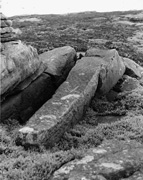
Object type: Rough-out of cross-shaft (?)
Measurements: L. (max.) 503 cm (198 in); W. 92 > 25 cm (36.5 > 10 in); D. 71 > 37.5 cm (28 > 14.75 in)
Stone type: Medium-grained grey sandstone (Carboniferous sandstone)
Plate numbers in printed volume: 621
Corpus volume reference: Vol 2 p. 162
(There may be more views or larger images available for this item. Click on the thumbnail image to view.)
Appendix A item (stones dating from Saxo-Norman overlap period or of uncertain date).
This area of the fell is littered with blocks of stone of similar formation, and this one need not be the product of human activity, but the taper on it and its close similarity in dimensions to the carved monolith in Bewcastle churchyard (no. 1) early called attention to it as a possibly unfinished sister monument (Maughan 1857, 10). Hewison (1914, 47) suggested that another site at Crossgreens, three-quarters of a mile north of the church, could have provided stone like that of Bewcastle 1. On the other hand, no-one else has voiced doubts that Long Bar, about five miles north-east of Bewcastle, is an appropriate quarry.
It is possible that this stone split when it was being cut free from its bed, and the surviving cross is its successor which was safely cut and transported down to the churchyard. The stone used for crosses in Cumbria was usually derived from a local quarry and, if not produced naturally, this block provides us with unique evidence for the system of production.
