Select a site alphabetically from the choices shown in the box below. Alternatively, browse sculptural examples using the Forward/Back buttons.
Chapters for this volume, along with copies of original in-text images, are available here.


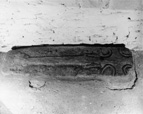
Object type: Large part of grave-cover
Measurements: L. 147.5 cm (58 in); W. 40.75 cm (16 in); D. 15.25 cm (6 in)
Stone type: Medium-grained grey sandstone (Carboniferous sandstone)
Plate numbers in printed volume: 622 - 3
Corpus volume reference: Vol 2 p. 162-163
(There may be more views or larger images available for this item. Click on the thumbnail image to view.)
Only one face is carved. The sides are smoothly dressed.
A (top): Filled by a shafted cross in low relief. The ends of the upper vertical and both horizontal arms are missing, but it is possible that the head was type B9. The head is outlined by a deep incision which gives the effect of a roll moulding and this moulding continues down the stem to form something like a socket over the shaft. The shaft tapers slightly towards a stepped base.
Appendix A item (stones dating from Saxo-Norman overlap period or of uncertain date).
Despite the similarity of the head type to that of no. 4, this may be a later form. Nevertheless, the carver's use of a double outline may be closely paralleled in pre-Conquest carvings: on a slab from Wensley, Yorkshire (Collingwood 1927a, fig. 17c); and one from Whithorn, Wigtownshire (Collingwood 1927a, fig. 6).
Stepped bases are usually associated with the post-Conquest period, but they occur as supports for early freestanding crosses in Ireland as at Kilkieran, co. Kilkenny (Henry 1965, pl. 78), Ahenny, co. Tipperary (ibid., pl. 79) and Lorrha, co. Tipperary (ibid., pl. 86) and with Anglo-Scandinavian crosses such as Gosforth 1 (Ills. 288, 292–5) and Halton, Lancashire (Kendrick 1949, pl. XLII).
