Select a site alphabetically from the choices shown in the box below. Alternatively, browse sculptural examples using the Forward/Back buttons.
Chapters for this volume, along with copies of original in-text images, are available here.


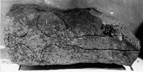
Object type: Part of grave-cover
Measurements: L. 94 cm (37 in); W. 42 cm (16.5 in); D. 14 cm (5.5 in)
Stone type: Medium-grained grey sandstone (Carboniferous sandstone)
Plate numbers in printed volume: 127 - 8
Corpus volume reference: Vol 2 p. 73-74
(There may be more views or larger images available for this item. Click on the thumbnail image to view.)
Only one face is carved. The top is roughly curved.
A (top): The surface is smoothly dressed and carries an incised cross, arm type B9 with pronounced wedge-shaped terminals. The top of the stem or shaft is tapered in just below the head.
Incised slabs such as this are notoriously difficult to date. The form of the cross head is not unlike that on a cross-incised grave-cover from Hexham which I have dated to the eleventh century (Cramp 1984, 183; pl. 181, 971), but there are some differences. The Hexham slab is neatly finished with an outer moulding, is more deeply carved, and the stem of the cross terminates in a base.
The rough outline of this stone is close in type to those in south-west Scotland such as Hoddom or Ardwall Island, which have been fully discussed by Thomas (1967b, 149–58). This waisted cross is similar to one from Anwoth and to an incised 'cut out' cross from Ardwall itself (Thomas 1967b, figs. 30 B, C, 31, no. 16).
