Select a site alphabetically from the choices shown in the box below. Alternatively, browse sculptural examples using the Forward/Back buttons.
Chapters for this volume, along with copies of original in-text images, are available here.


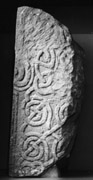
Object type: Tomb-cover, hogback, or part of large cross-shaft
Measurements: H. 100 cm (39.5 in); W. max. 35 cm (14 in); D. 33 cm (13 in)
Stone type: Greyish orange pink (5YR 7/2), poorly sorted, clast-supported quartz sandstone. The dominant quartz clasts vary from sub-angular to surounded, and range from 0.3 to 7 mm across, with a few grains up to 2 mm; scattered feldspar clasts occur. Millstone Grit Group, Carboniferous (C.R.B.)
Plate numbers in printed volume: Ill. 188
Corpus volume reference: Vol 13 p. 174-175
(There may be more views or larger images available for this item. Click on the thumbnail image to view.)
The stone is decorated on A only. A double roll moulding runs the length of the left-hand side of the stone.
A (broad): The bottom half of this face is decorated with spiralled pattern A interlace arranged in two vertical rows, although that on the right is fragmentary. Above, the pattern changes, becoming irregular, although damage means only two turned loops are clearly visible, so the irregularity may be more apparent than real. The double moulding on the left either marked the edge of the stone, or was a central divider; the row of interlace adjacent to it emerges from it at the bottom, suggesting the moulding may have framed one edge of a panel of decoration. Further confirming this is the fact that approximately half of another spiral, which appears to be connected to the pattern in the upper half of the stone, crosses over the moulding.
B (narrow), C (broad), E and F (ends): Broken away
D (narrow): Dressed-off flat
The decoration displayed on this stone is similar to that on the sarcophagus (Derby 7a), with which it shares the same interlace pattern as displayed on 7aA, while the change in design over the length of the panel is also seen on 7aC; this may suggest that the same sculptor was involved with both pieces, or that they emerged from the same centre of production. The main dilemma with this piece is the nature of its original form. While the vertical double moulding on the left may have marked the edge of the stone, the manner in which a spiral pattern crosses it and appears to continue to the left, suggests it may have been a central divide. Against this hypothesis are the dimensions of the stone. If the moulding is a central divider, then the piece would have been at least 90 cm wide, exceptional for either a tomb-cover or a cross-shaft; if, on the other hand, the moulding was at the edge of the stone its width was approximately 45 cm (17.7 in)–reasonable for a cross-shaft or a tomb cover. However, although the stone is presently 33 cm (13 in) thick, it was clearly originally larger–up to at least 35 cm (13.8 in) thick–since it has been cut back and dressed off; this would make it unusually thick for a flat slab tomb cover. It was with this in mind that Radford (1976, 47, fig. 5) identified the piece as part of a ‘high cross’. Yet, even if a cross of these dimensions can be accepted, the manner in which the double moulding is bridged by a spiral motif is highly unusual for a cross-shaft where the decoration is normally contained within discrete, framed panels. Another explanation is possible: the dressing, which presumably occurred when the sculpture was reused as a building component is, notably, rounded at both ends (E and F), a form that suggests the piece may once have been a large hogback, the ends and top of which have been dressed-off. The present left-hand edge would thus have been towards its base and the spiral over the moulding reached down towards the ground, perhaps, symbolically, towards the interred below.
