Select a site alphabetically from the choices shown in the box below. Alternatively, browse sculptural examples using the Forward/Back buttons.
Chapters for this volume, along with copies of original in-text images, are available here.


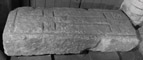
Object type: Grave-cover
Measurements: H. 132 cm (52 in); W. 45 cm (17.7 in); D. 28 cm (11 in)
Stone type: Yellowish grey (5Y 7/2), poorly sorted, shelly, dominantly clast-supported oolite, but some clasts and ooliths matrix supported. Ooliths vary from 0.4 to 0.7mm across; shells, both elongate and rounded (including a cidarid? spine), up to 5mm across are common. Lincolnshire Limestone Formation, Jurassic (C.R.B.)
Plate numbers in printed volume: Ills. 186–7
Corpus volume reference: Vol 13 p. 174
(There may be more views or larger images available for this item. Click on the thumbnail image to view.)
Decorated only on A, the other faces being plain. A single edge moulding surrounds the upper surface except at one end, which has been broken off.
A (broad): This face contains the incised plain shaft, approximately 10 cm (4 in) wide, of a double-barred cross contained by a wide flat frame running around the three surviving sides.
B and D (long): Rough and undecorated
C (end): Plain and slightly damaged
E (end): Plain with a shallow slot carved into it.
While it might seem doubtful that this tomb-cover is of pre-Conquest origin, its decoration being such that it could date from the end of the Anglo-Saxon period to the twelfth or even thirteenth century, Everson and Stocker have discussed the piece in relation to comparable monuments extant in Lincolnshire and Nottinghamshire, linking it to their ‘Mid Kesteven’ group of grave-covers, which they date to the late tenth-early eleventh centuries. With its framed double-barred cross it certainly has much in common with this group of monuments, although it lacks any decoration on its sides.
