Select a site alphabetically from the choices shown in the box below. Alternatively, browse sculptural examples using the Forward/Back buttons.
Chapters for this volume, along with copies of original in-text images, are available here.


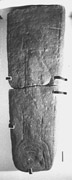
Object type: Grave-cover
Measurements: L. 142 cm (56 in); W. 45 > 35 cm (18 > 14 in); D. 20 cm (8 in)
Stone type: Pale red (5R 6/2), poorly sorted, clast-supported quartz sandstone. The sub-angular to rounded grains range from 0.4 to 1.5 mm across, with a few scattered feldspars up to 2 mm. Millstone Grit Group, Carboniferous (C.R.B.)
Plate numbers in printed volume: Ills. 184–5
Corpus volume reference: Vol 13 p. 173
(There may be more views or larger images available for this item. Click on the thumbnail image to view.)
Slightly convex in plan, the stone is decorated on one face only.
A (broad): The decoration is contained by a thin edge moulding which crosses the bottom of the stone above the lower edge. It consists of a shaft, approximately 10 cm wide, lightly incised with a double outline, which runs most of the length of the cover. At the top of the shaft there are traces of the lower arm and one side arm of a cross, whose upper part is broken away. The shaft terminates at the base in a cup-shaped terminal filled by a double-stranded interlace knot in triquetra form.
B and D (long): Rough and undecorated
C and E (ends): Plain and possibly broken
An unusual design for a grave-cover which, with the exception of the base of the cross-shaft, resembles a post-Conquest tomb-cover dating to the eleventh or twelfth century, or perhaps later. However, the triquetra knot and the unusual cup-shaped terminal (compare Lincoln Cathedral 1: Everson and Stocker 1999, ill. 230) suggest that it is more likely to be pre-Conquest in origin.
