Select a site alphabetically from the choices shown in the box below. Alternatively, browse sculptural examples using the Forward/Back buttons.
Chapters for this volume, along with copies of original in-text images, are available here.


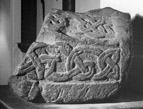
Object type: Part of hogback
Measurements: H. 38 cm (15 in); W. 35 cm (14 in); L. 30 cm (12 in)
Stone type: Heavily patinated and difficult to find a clean surface. Light olive grey (5Y 6/1), moderately sorted, clast-supported quartz sandstone. The sub-angular to rounded grains range from 0.2 to 0.4 mm across. Millstone Grit Group, Carboniferous (C.R.B.)
Plate numbers in printed volume: Ills. 180–3
Corpus volume reference: Vol 13 p. 172-173
(There may be more views or larger images available for this item. Click on the thumbnail image to view.)
Decorated on all faces, except where broken off, with flat strands of interlace bearing a central incision. The long sides (A and C) are edged with roll mouldings along the top and a broad plain area below; a broad cable moulding seems to have bordered the edges abutting B.
A (broad): Filled with a two-stranded interlace pattern that terminates in a ‘Stafford knot’ on the right. About half-way along the panel one strand resolves into a serpentine animal-head facing left, its mouth biting on a further strand.
B (narrow): Dressed-off and drilled with two blind holes; no decoration survives.
C (broad): This face is filled with a three-strand interlace pattern which appears to terminate in a closed loop at the left-hand end with one strand disappearing beneath it. Two loops are visible but only one is complete; that on the right is damaged and incomplete.
D (narrow): Broken
E (top): The coped upper surface is divided in two by a broad central ridge, now badly damaged, which terminates at one end (contingent with B) in an animal head with a tapered muzzle facing down the length of the stone (away from B). Above A the panel contains an interlace pattern composed of three strands; two terminate below the central ridge over B and the other terminates in a slightly enlarged curled-back end resembling a berry. Only one loop of the interlace is complete. The panel over C is badly worn and indistinct, but seems to have contained an interlace pattern, perhaps mirrored, but this is unclear; only a general scheme of simple two-stranded loops can be discerned.
Other than the piece once recorded at Repton (no. 18, Ills. 347-8), hogback monuments are relatively rare in the Midlands; elsewhere they are generally assumed to have rested over a grave and are related to the period of Scandinavian settlement (e.g. Lang 1984). The surviving animal head at one end of the gable ridge strongly suggests that like other examples a similar (confronting) head would have adorned the other end of the stone. Lang (1984, 89) associated the monument type with Norse settlement and particular locations on the edge of relatively marginal land. However, this does not seem to apply to Derby, although further to the north of Derby, such landscapes exist. Whether the monument was erected to commemorate a Norseman is unknown; unlike York where control is known to have been held periodically by both Danes and Norsemen, the leaders of Viking-period Derby are not recorded.
The fragmentary nature of the interlace patterns mean they are difficult to parallel, but the curled terminal of the interlace strand on E is also found elsewhere in the region: at Asfordby in Leicestershire, for example (Sidebottom 1994, 214), suggesting that it was locally produced during the period of Scandinavian settlement.
