Select a site alphabetically from the choices shown in the box below. Alternatively, browse sculptural examples using the Forward/Back buttons.
Chapters for this volume, along with copies of original in-text images, are available here.


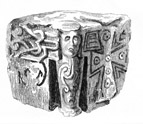
Object type: Impost
Measurements: H. c. 30 cm (11.8 in); W. c. 30 cm (11.8 in); D. unknown
Stone type: Unknown
Plate numbers in printed volume: Ill. 473
Corpus volume reference: Vol 13 p. 257-258
(There may be more views or larger images available for this item. Click on the thumbnail image to view.)
This is one of a pair of imposts (see Derby 13) now only known from a drawing included in Stevens’ letter of 1845 ((—) 1845b, fig. following 76) which was reproduced by Cox (1879). Only two faces of the impost (A and B) were illustrated.
A: The illustration shows a form of triquetra design with two strands of interlace passing through it, below which is an area which appears to have been worn away so that its decoration is indistinct. To the right, on the corner of the impost, is an area deeply carved away around a tapered, round, column head which appears to have been quite narrow (possibly only c. 7 cm (2.75 in) in diameter) if Cox’s description of its measurements is correct. The column head is decorated with some form of narrow-stranded interlace (unclear) with a human head above it, reaching to the top of the impost.
B: This face is decorated with a Maltese cross with circular motifs on the arms and a thin moulding surrounding it. At the top left-hand of the impost, on the shoulder of the cross, is a square linear motif. The other shoulder of the cross appears decorated but is unclear.
C and D: Unknown
Appendix B item (stones wrongly associated with pre-Conquest period)
This piece was not mentioned by Routh (1937a; 1937b) in his description of Anglo-Saxon sculpted stones from Derby, and Radford (1976) called on the original illustrations submitted by Stevens in 1845, along with Cox’s description (Cox 1879), and Clapham’s discussion of the two pieces (1930, 124-6). As with Derby 5 (p. 169) there is no way to know how accurate the drawing may have been; it could have been an interpretation of a scheme of decoration which was difficult or impossible to decipher accurately, but the ring pattern on 13A/B and the incorporation of a human head over the angle-column on 12A/B is in keeping with general trends in post-Conquest sculptural capitals and imposts. The impost is thus unlikely to have been Anglo-Saxon and a Norman context seems more appropriate—despite its association with pre-Conquest activities by Stevens, Cox, Clapham and Radford, perhaps because both pieces were deemed to have ‘formed part of a comparatively small opening’ (Radford 1976, 45).
