Select a site alphabetically from the choices shown in the box below. Alternatively, browse sculptural examples using the Forward/Back buttons.
Chapters for this volume, along with copies of original in-text images, are available here.


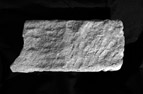
Object type: Cross-arm
Measurements: H. 21 cm (8.3 in); W. 35 cm (14 in); D. 15 cm (6 in)
Stone type: Greyish orange pink (5YR 7/2), poorly sorted, clast-supported quartz sandstone; a few pink feldspars are present. The sub-angular to sub-rounded grains range from 0.3 to 2 mm across, but are dominantly in the range 0.4 to 0.5 mm. Millstone Grit Group, Carboniferous (C.R.B.)
Plate numbers in printed volume: Ills. 161–5
Corpus volume reference: Vol 13 p. 170
(There may be more views or larger images available for this item. Click on the thumbnail image to view.)
This stone was once an arm of a cross-head with apparently wedge-shaped terminals. No details of the armpits or central arrangement are present, but it is clear that the terminal of the arm (B) survives as the upper part of this face is decorated.
A (broad): This face, displayed in the same vertical plane as its shaft, is decorated with a three-stranded interlace pattern which is slightly irregular and terminates in a two turned loops with the third strand lacing over the left-hand loop and meeting the inner moulding containing the pattern.
B (narrow): The end of the cross-arm and, therefore, seen from the side of the monument, this face has a broad outer moulding of indeterminate type with a thinner inner (possibly roll) moulding. The area between the outer mouldings is raised and plain.
C (broad): This face is badly weathered but appears to be decorated almost exactly as A, providing the decorative scheme as on the other side of the cross-head. Slight variations in the position of the strands of interlace suggests that no template was used to construct the pattern.
D (narrow): This face is broken, where the arm has been broken off the rest of the cross-head.
E (top): Most of this face has been dressed-off leaving only the small area of double edge moulding where the arm narrows towards the centre of the cross-head. The rest of the field appears to have been a raised plain area between the edge mouldings.
F (bottom): This face has been badly damaged by subsequent dressing and only a fragment of the decoration survives; this appears to be similar to that on B, but is badly weathered and pitted.
This was the arm of a relatively large cross-head, at least 90 cm in diameter when complete, and its decorative scheme, a complex three-stranded interlace, is not uncommon in the Derby area (see e.g. Clipshead 1, Ills. 132-6), although it cannot be related to any of the cross-shafts found at Derby St Alkmund (1–3).
