Select a site alphabetically from the choices shown in the box below. Alternatively, browse sculptural examples using the Forward/Back buttons.
Chapters for this volume, along with copies of original in-text images, are available here.


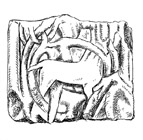
Object type: (?)Fragment of a cross-shaft
Measurements: H. c. 55 cm (22 in); W. c. 80 cm (31.5 in); D. unknown
Stone type: Unknown
Plate numbers in printed volume: Ill. 160
Corpus volume reference: Vol 13 p. 169-170
(There may be more views or larger images available for this item. Click on the thumbnail image to view.)
Cox (1879, 122) recorded this piece as surviving only as a cast of a lost fragment of cross-shaft from St Alkmund’s, Derby. The cast is now missing and in 1976 Radford had to use Cox’s illustration to assess the sculpted decoration. If the illustration of the cast is faithful to the original stone, then the fragment appears broken on the top, bottom and right-hand side.
A (broad): Cox’s illustration shows a profile quadruped fettered by interlace and possibly part of an inhabited plant-scroll scheme with foliate tendrils in the top left entwining the scrolling. On the left there seems to be a plain roll moulding suggesting it was part of a cross-shaft. Clearly the original stone was damaged or worn, as the illustration is unclear in several areas.
B and D (narrow) and C (broad): Not recorded
This piece was not mentioned by Routh (1937a/b) in his description of Anglo-Saxon sculpted stones from Derby, and Radford (1976) called on Cox’s 1879 description and illustration in order to include it in his corpus of sculpture from St Alkmund’s, Derby. It may be that Routh did not consider it to be an Anglo-Saxon piece or omitted it because it was lost. If the illustration is accurate, the original stone appears to have been decorated with part of an inhabited plant-scroll, which would make it unique among the extant Derby corpus. However, there is no way to know how accurate the drawing may have been; it could have been the interpretation of a scheme of decoration that was difficult or impossible to decipher accurately. The possible roll moulding, however, suggests that it was very likely part of a cross-shaft, and the form of the quadruped and the plant-scroll are generally in keeping with sculpture said to be dated to the ninth century.
