Select a site alphabetically from the choices shown in the box below. Alternatively, browse sculptural examples using the Forward/Back buttons.
Chapters for this volume, along with copies of original in-text images, are available here.


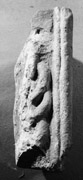
Object type: Part of a cross-shaft
Measurements: H. 39 cm (15.25 in); W. 30 cm (11.8 in); D. 15 cm (6 in)
Stone type: Yellowish grey (5Y 7/2), well sorted, clast-supported quartz sandstone. The sub-angular to sub-rounded grains range from 0.3 to 0.5 mm across. Clasts of white mica up to 1.5 mm are common. Sherwood Sandstone Group, Triassic (C.R.B.)
Plate numbers in printed volume: Ills. 158–9
Corpus volume reference: Vol 13 p. 168-169
(There may be more views or larger images available for this item. Click on the thumbnail image to view.)
Where the carving survives, on A and D, it is bounded by a plain outer roll moulding inset with a thinner inner roll moulding.
A (broad): The framing mouldings are visible on the left but the right-hand edge of the stone has been cut back. A central vertical moulding divides the field in two; near the top it bifurcates to form arches that enclose the heads of two standing figures flanking the central moulding, and continues round to their shoulders. Above the arches the central moulding continues up into the upper break. Both figures face forwards; although worn their eyes seem to have been deeply drilled. They grasp the central moulding with their outer arms bent across their bodies; the arms next to the moulding also cross their bodies at waist height, so that their hands are tucked in under the elbows of the outer arms. Both wear garments with short flared skirts.
B (narrow): Cut back and roughly dressed
C (broad): Broken
D (narrow): Between the framing mouldings and the vertical break in the stone are three strands that curl up and to the left, with a fourth apparently crossing them diagonally towards the upper right-hand corner.
Schemes that feature pairs or groups of figures conjoined by their haloes/hair, limbs, or some other detail feature widely in the corpus of Anglo-Saxon stone sculpture. They survive elsewhere in Derbyshire on Hope 1, and in Staffordshire on Checkley 1 and 2 and Ilam Estate 1. Further afield is the well-known group in Co. Durham–at Aycliffe (1, 3–4, 6–7, 9, 13) and Gainford (1 and 3), which Cramp (1984, 42) has suggested may reflect the arrangement of panelled figures on the earlier (late eighth-/early ninth-century) cross standing locally at Auckland St Andrew (1).
On the Northumbrian carvings, however, the figures wear garments with pleated skirts, and hold individual crosses and books; none grasp a central moulding dividing them and neither do they hold their attributes in the conspicuous cross-armed pose featured on Derby 4. This latter detail is, however, also articulated on Hope 1C where two figures grasp a tall staff-cross between them, the arms of the figure on the left crossing the body to do so (Ill. 219). But these figures are shown in profile, and while their ‘haloes’ enclose the backs of their heads in a line contiguous with their shoulders, they are not apparently conjoined between them. Likewise, the pair of figures on Hope 1A which appear to be more forward-facing and hold their arms across their bodies, have haloes (or hoods) that form a continuous line from their shoulders around their heads but are not conjoined; neither do they grasp a cross or central moulding (Ill. 216). Rather they appear to embrace each other, and that on the left may hold a book. And, while the stones at Checkley and Ilam are badly weathered, from what survives it appears that although conjoined by haloes or limbs none of the figures grasps a vertical element set between them.
Thus, although Derby 4 displays characteristics linking it in a general way to a distinctive group of carvings, locally and further afield, it stands as iconographically unique in the extant corpus of Anglo-Saxon stone sculpture in terms of its specific arrangement and iconographic details. The fact that the central vertical moulding extends beyond the bifurcation of the ‘haloes’ enclosing the figures’ heads suggests that they do not grasp a staff cross; rather, they were part of a wider scheme, perhaps featuring pairs of figures running the length of the shaft. Indeed, the way the moulding morphs into them recalls the way the central moulding on Sandbach Market Square 1 and 2, in Cheshire (Bailey 2010, 99–122), and the related fragment preserved at Bakewell (15B) branches out to merge with the figures disposed on either side of it (Ills. 42, 644). Like the schemes in Co. Durham it may be that the Derby piece presents a reflex of earlier iconographic schemes, in this case the scheme identified as an articulation of the Spiritual Ladder (Hawkes 2002a, 64–75; Bailey 2010, 96, 111).
Clearly any intention to reproduce or re-articulate such an iconographic scheme at Derby cannot be ascertained; the carving is too fragmentary and the arrangement too diverse in its details to allow for such a specific identification. Nevertheless, the overall disposition of the figures indicates that they may well have emerged from a scheme not at odds with the iconographic significance articulated by a scheme such as the Spiritual Ladder, by which members of the Christian community were shown linked to heaven by means of a central feature denoting their spiritual ascent to life eternal. At the very least, the iconographic relationship of the Spiritual Ladder with the Tree of Life may indicate that the Derby figures were intended to communicate (through the branch-like nature of the central moulding and its bifurcating stem), their membership as a Christian community linked in faith.
