Select a site alphabetically from the choices shown in the box below. Alternatively, browse sculptural examples using the Forward/Back buttons.
Chapters for this volume, along with copies of original in-text images, are available here.


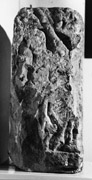
Object type: Part of a cross-shaft
Measurements: H. 60 cm (23.5 in); W. 34 cm (13.4 in); D. 24 cm (9.5 in)
Stone type: Yellowish grey (5Y 7/2), clast-suported, shelly, oolitic limestone. The ooliths, which range from 0.3 to 0.6 mm, stand proud. Scattered angular to platy shells fragments up to 6mm occur. Lincolnshire Limestone Formation, Jurassic (C.R.B.)
Plate numbers in printed volume: Ills. 155–7
Corpus volume reference: Vol 13 p. 165-168
(There may be more views or larger images available for this item. Click on the thumbnail image to view.)
The remains of the carved decoration surviving on A, B and D was originally contained within arched panels formed by roll mouldings bounded by wide flat angle mouldings.
A (broad): The arch framing the panel rises from a square capital on each side; the area above the arch contains the remains of carved relief of an indeterminate nature. The flat horizontal base moulding retains traces of interlace in the right-hand corner. The deeply recessed panel is dominated by a profile figure, turned to the right, and seated on a stool ornamented with parallel ribs, which is supported by a stepped pedestal. The head of the figure, half-turned towards the spectator, has shoulder-length hair that falls thickly on either side of the face. The legs are visible on the right with heavy folds of drapery lying across the right knee; the right leg appears to be clothed in ankle-length leggings. Resting on the right knee, and crossing the body, is a large sword, encased in a scabbard with a rounded terminal that intrudes slightly into the roll moulding (column) on right. The figure grasps the scabbard below the triangular pommel of the sword with the right hand, the pommel itself lying under the right elbow; the straps and clasps attaching the scabbard to the belt are visible along its length. Above the sword is an object covering the torso of the figure. It consists of a slightly tapering rectangular shape traversed vertically by two deep incisions that begin below the upper edge, and terminate two-thirds of the way down. It is supported by the figure’s left hand, which emerges from a fold of flowing drapery. Above this object, under the curve of the arch, is a foliate motif that terminates in a series of curved fleshy tendrils by the head of the figure. A prominent circular motif hangs from the main branch over the rectangular object resting on the figure’s lap.
B (narrow): The decoration on this face has been roughly dressed, but originally contained a human figure within the arched panel. The outline of the head and shoulders of this figure are visible, while the right arm survives to the elbow, being originally bent across the body. Over the left shoulder is an object folded back on itself, the identity of which cannot be discerned.
C (broad): Roughly dressed with a slot that runs from the base for a third of its height.
D (narrow): The decoration has been roughly dressed and cut back, but the deeply recessed arched panel originally contained a profile figure with a prominent nose and shoulder-length hair–details still visible in the upper part of the panel. A long staff or sword is held upraised behind the head in the upper right of the panel, such that it obtrudes over the upper frame, terminating in a rounded point at the edge of the stone. On the left, just below the face, is a shield held in three-quarter view over the chest of the figure; the collared boss at centre of the shield is clearly visible. The central part of the panel has been damaged and roughly cut back, but on the lower right are a series of angled features, resembling the legs of a horse, which rest on the upper edge of the flat horizontal band at the base of the panel.
Only the figural ornament on A has elicited comment by previous scholars, largely because it is the only carving which is clearly visible. Without the aid of additional (cross) lighting the vestigial remains of B and C are not at all clear in its current setting. Despite this relative advantage, however, the figure on A has hitherto been identified as a Virgin and Child (Radford 1976, 52–3; Hawkes 1997a, 108). Nevertheless, with proper observation, and under favourable lighting conditions, it is apparent that the figure must be identified as a male figure grasping a long sword across his body with one hand. Likewise, the object that the figure supports on his knees by the other hand, consisting of a ‘frame’ around both sides and across the base, is perhaps better explained as resembling a harp, rather than the body of a child (without legs), while the circular motif situated above, being suspended from the foliate element under the arch, is best understood as part of that plant, rather than the ‘head’ of a child. The panel thus consists of a seated male figure holding a sword and a harp, with the vestiges of a foliate motif above.
Stylistically, the combination of the rather heavy and florid drapery folds with the figure clearly delineated underneath, and the fleshy nature of the foliate motif above, suggest the carving was produced under the influence of the so-called ‘Winchester style’ which flourished in southern England during the tenth century (Wilson 1984, 160–76, 195–200). Iconographically, the identification of the figure as male and enthroned with a sword and harp might encourage explanation of the panel as depicting David the Psalmist. However, even within the varied iconography of David with the harp in early medieval Christian art, there does not seem to be any tradition of portraying the harpist with a sword.
On the other hand, portraits of kings enthroned with this attribute do survive, in Carolingian contexts and in later Anglo-Saxon art produced under Carolingian influence. Psalm 151 of the ninth-century Utrecht Psalter, for instance, depicts a king (probably Saul) seated under a canopy, in a slightly three-quarter turned pose, grasping a sword with a triangular-shaped pommel which crosses his body, resting on his knees (Utrecht, University Library, MS 32, fol. 91v: see Ill. 650). The sceptre held in his left hand has a large circular terminal. Not included in the Psalter’s main sources, this miniature is thought to have been compiled by the artists of the manuscript from illustrations elsewhere in the Psalter (a similar figure is found at Psalm 13 on fol. 7v), and from an illustrated Book of Kings (van der Horst 1996, 75).
As such, this king represents one of a number of regal figures depicted in various contexts in Carolingian and later Anglo-Saxon art. The royal portrait frontispiece to the Psalter of Charles the Bald, for instance, depicts the king enthroned with a large sceptre with a circular terminal at one end and a pommel-like terminal at the other (Paris, Bibl. Nat. MS lat. 1152, fol. 3v), while the enthroned figure of the ‘mighty man’ illustrating Psalm 51 in the much later Paris Psalter, whose illustrations derive from the Utrecht and Harley Psalters, is similarly equipped with a large sword (Paris, Bibl. Nat. MS lat. 8846, fol. 89r).
This long-lived pictorial tradition of portraying regal figures enthroned with swords and/or large sceptres with terminals of varying shapes may thus go some way towards explaining the figure depicted on the Derby stone. And although the harp is never an attribute of such figures, there was an equally long-lived tendency, from the ninth century onwards, to relate secular rulers with the Old Testament figure of David, a correlation that contributed in part to the inclusion of the secular regal portraits in the Carolingian Psalters, the contents of which were traditionally associated with the Old Testament psalmist and king. Within the early medieval Insular world, the iconographic programme of the ninth-century St Andrews Sarcophagus has long been explained within this context (Henderson 1998, 154–5). It seems, therefore, that the Derby St Alkmund carving is perhaps best understood as a regal figure (denoted by the sword and enthroned pose), who was intentionally being associated (visually by the harp), with David, the Old Testament king who, by the ninth century had become an exemplar of early medieval ruler-ship (see Stoner 2017a).
Unlike the figure on A, the remains of that on B are so badly damaged it is impossible to identify it, and although more remains of the figure on D, its identity is also uncertain. It was clearly depicted in the attitude of combat, leaning forwards to the left, with a sword upraised behind the head, and a shield held over the chest. Beyond this it is impossible to determine whether the figure wore a helmet and/or armour. The carved remains in the lower right of the panel are nevertheless echoic of a horse’s hind legs, and ninth-century icons of rider saints depict their subject in vertical narrow frames in which the horse’s head is turned back so that it is situated in front of the rider, with the legs being set close together (Nelson and Collins 2006, fig. 102). On these icons, the rider saint is not armed; rather, he bears a staff-cross in one hand and holds the reins upraised in the other Thus, although damaged, and featuring the accoutrements of a warrior, the arrangement of rider and horse featured within the narrow vertical field of the shaft are best explained by the layout of icons featuring rider saints.
Nevertheless, understanding the panel as containing a mounted figure does not identify him. The possible presence of a secular ruler presented in Davidic terms on A, might suggest a Davidic interpretation for this figure, but within the corpus of extant images of David in early medieval art, it is hard to find a convincing parallel for the rider preserved on D. Moreover, the presence of one figure produced under a given set of influences in Anglo-Saxon sculpture does not mean that a second will be included. Alternatively, it is possible that the carving portrays a secular figure on horseback. Although this subject-matter is rare in the corpus of pre-Scandinavian period sculpture, it occurs with more regularity in material from the Scandinavian period, and is also a feature of ninth- and tenth-century (manuscript) art from southern England where, however, such figures tend not to be equipped in the manner set out on Derby 3.
In this respect, the closest analogy is perhaps the armed rider on the remains of the late eighth-/early ninth-century shaft nearby at Repton (1), or the horseman bearing his shield set in the roughly contemporary cross-head of Bakewell 1 (Ills. 15, 247). It has been widely established that both Repton and Derby saw the cultivation of royal martyr saints’ cults–of St Wystan and St Alkmund, respectively–during the course of the eighth and ninth centuries (Rollason 1981; id. 1983; Thacker 1985; Ridyard 1988; Cubitt 2000a; id. 2000b), while the cults of murdered and martyred royal saints received particular ecclesiastical patronage in the tenth and eleventh centuries in response to the continued local popularity enjoyed by the cults (Cubitt 2000a; 2000b). Given that both sites demonstrate the continued production of sculpture through the Scandinavian period (e.g. Repton 4, Derby 4 and 9), it seems likely that the cult of St Alkmund enjoyed something of a further revival during the course of the tenth or early eleventh century as part of this process of continual local popularity and subsequent ecclesiastical activity during the Benedictine Reform, and was articulated visually in a stone medium under the influence of earlier sculptural traditions. Whether memories of the monument featuring the victorious rider at Repton influenced the choice to utilise this distinctive carved motif at St Alkmund’s, the figure on horseback provides another instance of the cluster of such figures, unusual in the corpus of Anglo-Saxon generally, that survives in this region, while also demonstrating access to good quality contemporary art of probably southern English provenance.
