Select a site alphabetically from the choices shown in the box below. Alternatively, browse sculptural examples using the Forward/Back buttons.
Chapters for this volume, along with copies of original in-text images, are available here.


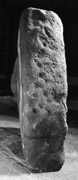
Object type: Possibly part of a cross-shaft or grave slab
Measurements: H. 63 cm (25.2 in); W. 44 > 36 cm (17.6 > 14.4 in); D. 19 > 17 cm (7.5 > 6.8 in)
Stone type: Poorly to moderately sorted, clast-supported, pale red (5R 6/2) feldspathic sandstone. The sub-angular to sub-rounded grains vary from 0.2 to 0.8 mm, but are mostly between 0.4.and 0.5 mm (C.R.B.)
Plate numbers in printed volume: Ills. 144–5
Corpus volume reference: Vol 13 p. 161-162
(There may be more views or larger images available for this item. Click on the thumbnail image to view.)
This piece has fragmentary decoration surviving on two faces only. It is also damaged, worn and broken, making it difficult to interpret the surviving scheme of decoration. That which remains visible is described below.
A (broad): This face is decorated with several moulded strands which may have formed an interlace pattern, or possibly the remains of a biped (back to the right) with extended limbs (extending up to the left). At the top the stone is plain where the decoration has either been worn away or was not originally decorated. About half-way down is a moulded strand of changing thickness which undulates horizontally; it thickens towards the left and may have formed a serpentine motif, although it is too worn and damaged to be certain. Another moulded strand branches downwards from this element to join a complex design on the bottom right-hand side. The design here is difficult to decipher; there are two large pellets, one or both of which could have represented human heads although this is far from clear. Between the pellets is a raised area from which moulded strands appear to extend, encircling the pellets. At the left-hand extremity of the raised area is another moulded strand which extends to the left-hand edge of the surviving decoration. It, too, undulates horizontally like the strand above it. The decoration is truncated at the bottom where the stone is broken.
B (narrow): Broken and damaged with no surviving decoration.
C (broad): Worn smooth, probably through subsequent reuse, with no decoration surviving. A small diagonal slot, about 7 cm (2.75 in) long, has been incised roughly in the centre; its function is unknown.
D (narrow): This face is badly worn with part missing where it appears to have been dressed-off. There are the remains of a simple moulded interlace pattern, probably comprising a four-stranded plait, although this is only apparent at the base; the rest is too badly damaged to identify. This face is now curved but this is likely to represent subsequent dressing, possibly for reuse.
The original function of this stone is not entirely clear. The remains of an interlace or plait on D suggest it might have been a cross-shaft but, if these remains represent the full extent of the decoration on D it would imply a monument of unusually narrow dimensions for this region. However, the extant decoration on this face may have formed one panel of a more extensive arrangement, similar to Darley Dale 4 where at least one human figure stands alongside a three-stranded interlace, suggesting a shaft of more usual dimensions. Alternatively, the stone can be explained as a relatively thick grave slab which was decorated around its narrow sides (hence the interlace pattern on D) and on only one broad face (A). Whatever its original function, it is clear that the stone was subsequently reused, being re-dressed to produce a curved surface (D); the damage to B might also be the result of reuse. Face C is worn so smooth it might suggest that the stone was reused as a step or the side of a stile (see Bradbourne 1). Overall, the fragmentary condition of the decoration means there are no diagnostic features on A to indicate a pre-Conquest date. However, the remains of the simple four-stranded interlace on D suggest that it may be Anglo-Saxon in origin, and the pellets situate it generally within the visual repertoire of the region.
