Select a site alphabetically from the choices shown in the box below. Alternatively, browse sculptural examples using the Forward/Back buttons.
Chapters for this volume, along with copies of original in-text images, are available here.


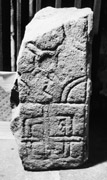
Object type: Part of a grave-marker or possibly part of a cross-shaft
Measurements: H. 61 cm (24.5 in); W. 28 cm (11.1 in); D. 18 > 17 cm (7.1 > 6.8 in)
Stone type: Poorly sorted, clast-supported, greyish orange pink (5YR 7/2), feldspathic sandstone. The sub-angular to sub-rounded grains vary from medium (0.3 mm) to coarse (1.0 mm), but are mostly coarse-grained between 0.5 and 0.8 mm. Millstone Grit Group, Carboniferous (C.R.B.)
Plate numbers in printed volume: Ills. 141–3
Corpus volume reference: Vol 13 p. 160-161
(There may be more views or larger images available for this item. Click on the thumbnail image to view.)
Decoration survives only on A and B.
A (broad): The decoration is arranged in two panels divided by a horizontal incised line. That in the upper panel appears to have been a cross with tapering arms, terminating on each side at the edge mouldings and at the lower panel divide; the top is lost to the break in the stone. In the centre of the cross-head there is a circular depression surrounded by a flat moulding, contiguous with four short arms radiating diagonally towards the armpits of the cross articulated by a single moulding. The lower and smaller panel is decorated by another (linear) cross formed by a single moulding; a square, also formed by a single moulding, frames the intersection of the cross.
B (narrow): This face is decorated by a key pattern contained by edge mouldings on each side. The top and bottom are lost in the breaks in the stone.
C (broad): Although badly, worn decoration appears to have been divided into two panels as on A; parts of the left-hand edge moulding and central divider are visible and there appears to be a trace of a lower horizontal moulding.
D (narrow): Broken
This is an unusual piece which, in part, resembles a grave-cover similar to Derby 7 or 8, although the traces of decoration on C suggests that the stone was intended to stand upright and be visible from all sides. The unusual scheme of decoration raises some doubt that this was ever part of a cross-shaft, but as the stone is incomplete and damaged it is not possible to assess its original height. If it comprised no more than the two panels visible on A and C, it may well have been a grave-marker, providing an unusual example of decoration associated with recumbent monuments applied to a freestanding memorial. Nevertheless, although the incised and shallow nature of the carving is different to the higher relief of most of the cross-shafts in the region, there are incised examples elsewhere, at Ecclesfield or Penistone in west Yorkshire, for instance, which have been dated to the eleventh century (Coatsworth 2008, 150-1, 229).
