Select a site alphabetically from the choices shown in the box below. Alternatively, browse sculptural examples using the Forward/Back buttons.
Chapters for this volume, along with copies of original in-text images, are available here.


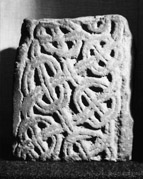
Object type: Part of a cross-shaft
Measurements: H. 45 cm (18 in); W. 37 cm (14.8 in); D. 28 > 25 cm (11.2 > 9.9 in)
Stone type: Moderately sorted, clast-supported, moderate reddish orange (10R 6/6), feldspathic quartz sandstone. The sub-angular to sub-rounded grains vary from fine (0.2 mm) to coarse (0.7 mm), but are mostly medium-grained between 0.4 and 0.5 mm. Millstone Grit Group, Carboniferous (C.R.B.)
Plate numbers in printed volume: Ills. 137–40
Corpus volume reference: Vol 13 p. 159-160
(There may be more views or larger images available for this item. Click on the thumbnail image to view.)
The stone is decorated on all sides with carving showing a lack of symmetry and appears to have been carved freehand. There are arrises on each corner which are damaged but may have been roll mouldings.
A (broad): This face is decorated with a simple two-stranded interlace pattern, each strand demarcated by an incised median strip; at the end of each diagonal is a closed-circuit ring which the strands pass over (ascending left to right) and under (ascending right to left) (closed circuit pattern A: Cramp 1991, fig. 24). The pattern is incomplete with the top and bottom missing but it appears that the pattern repeated itself above and below.
B (narrow): This face has a simple two-stranded interlace pattern, the strands of which pass through what appears to be closed-circuit ‘figure-of-eight’ loops that touch each other (simple pattern F: Cramp 1991, fig. 23), although only two such patterns are visible and both are incomplete. The strands may have been median-incised, like those on A, but the surface is damaged by tool marks probably made when the stone was reused as building fabric.
C (broad): This face is decorated with a four-strand plain plait arranged to give the appearance of a ‘basket-weave’. The strands are median-incised like those on A. Tool marks towards the bottom likely date from the time the stone was reused as building material.
D (narrow): Only a fraction of the decoration survives on this face, the greater part of the lower face being dressed-off. The surviving portion indicates that the decoration consisted of a two-strand (median-incised) interlace pattern arranged in ‘figure-of-eight’ closed-circuit loops like that on B, although only the junction between loops survives.
The stone is fragmentary and only simple interlace patterns survive. The carving appears freehand and lacking in symmetry. The pattern on A is similar to that observed on the piece from Derwent (1) which has now been destroyed and the ‘basket-weave’ on C is similar to Bakewell 6, or Norbury 1C, all of which seem to be Anglo-Scandinavian products.
