Select a site alphabetically from the choices shown in the box below. Alternatively, browse sculptural examples using the Forward/Back buttons.
Chapters for this volume, along with copies of original in-text images, are available here.


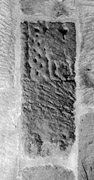
Object type: Probably part of a cross-shaft
Measurements: H. 29 cm (11.5 in); W. 62 cm (24.9 in); D. unknown
Stone type: Buff-coloured sandstone, probably Millstone Grit
Plate numbers in printed volume: Ill. 146
Corpus volume reference: Vol 13 p. 162
(There may be more views or larger images available for this item. Click on the thumbnail image to view.)
This stone is built in lengthwise, with the decoration to the left, but is described and illustrated as if standing upright.
The visible face is decorated over half of the stone only, the remainder being dressed-off. This may have been the base of the monument and could have been left undecorated as that part intended to be placed into the ground or in a socket. The upper half of the stone is decorated on the left-hand side by a simple interlace which is a three-stranded plait that appears to become irregular at the extreme upper end where the pattern is truncated. It terminates below by two of the strands making a return loop with the other having its end resting on the base of the panel. To the right of the interlace is a human figure, the upper part of which is badly worn and damaged. The figure wears a knee-length tunic with legs visible below and feet turning to the right. There also appears to be an arm extending to the right but this part is very worn. There seems to be a second figure immediately to the right, of which only a small part is visible, including one leg with the foot turned to the left to face the first figure. The feet of both figures rest on an incised line, separating them from the dressed-off area below. There appears to be a sword diagonally across the centre of the body of the main figure; it is however, badly worn.
This piece is too fragmentary to draw any particular parallels with other shafts in this volume, although the use of a three-strand interlace suggests that it may be Anglo-Scandinavian. The presence of figures with tunics and turned feet are found on pieces elsewhere and is a common motif in this region (and elsewhere). One example would be the shaft at Hope (1) which has similar paired figures (Ills. 216, 219). The employment of a three-stranded interlace is, again, not uncommon in this region.
