Select a site alphabetically from the choices shown in the box below. Alternatively, browse sculptural examples using the Forward/Back buttons.
Chapters for this volume, along with copies of original in-text images, are available here.


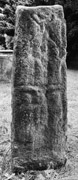
Object type: Part of shaft [1]
Measurements: H. 136 cm (53.5 in); W. 49 > 34 cm (19.25 > 13.4 in); D. 34 > 24 cm (13.4 > 9.5 in)
Stone type: Pink to light brown (5YR 6/4) greyish orange pink (5YR 7/3), moderately sorted, clast-supported, quartz sandstone. The sub-angular to sub-rounded grains range from 0.4 to 2 mm across, but are dominantly medium grained in the range 0.5 to 0.7 mm. Interstitial pink to white barytes is present. Helsby Sandstone Formation, Sherwood Sandstone Group, Triassic (R.T. & C.R.B.)
Plate numbers in printed volume: Ills. 519, 526–9
Corpus volume reference: Vol 13 p. 278-280
(There may be more views or larger images available for this item. Click on the thumbnail image to view.)
All four vertical edges of the shaft are bounded by a plain angle moulding. Approximately half-way along its length each face is divided into two panels by a thin plain horizontal roll moulding that is not contiguous with the angle mouldings. On B, C and D the upper panel is bounded by a similar moulding across the top, just below the break. On all four faces it appears that the carving terminated approximately 30 cm (11.75 in) from the base of the shaft.[2]
A (broad): (i) In the upper panel are the worn remains of three figures wearing full-length robes that terminate at the edge of the horizontal moulding. There is no sign of feet emerging from the hemlines; nor is there any sign of arms. Above the heads are the worn remains of a fourth figure wearing a full-length robe that flares out widely so that its outer edges touch the heads of the two outer figures below. The head of this figure survives just below the upper break in the stone, and its arms are upraised on either side of the head, extended towards the upper corners of the panel, while the area between the arms and the flared skirt is filled on each side by large tear-shaped elements resembling wings whose tips touch the edge of the outer angle moulding (although see Plunkett 1984, pl. 40). (ii) The lower panel is filled with the worn vestiges of three further full-length figures wearing robes that may have been pleated. The erosion sustained to this part of the shaft, however, means this is far from certain. There is no indication of where their arms may have been positioned, although the right arm of the figure on the left may cross its body to touch the shoulder of the central figure. The heads of all three figures are round, and that of the central figure is set closer to the upper horizontal moulding than those of the two flanking figures.
B (narrow): (i) The upper panel is filled with an interlaced zoomorph: the body, a wide flat meandering ribbon with no forequarters, forms two triquetra knots from the extension of its tail; the long head (with a square-ended snout and small ears) is back-turned on itself in the lower left-hand corner; and the uppermost turn of the body is inset with a pellet. (ii) The lower panel is filled with two full-length figures whose round heads rest on bodies with squared shoulders; no arms or feet are visible in the damaged portion at the base of the shaft.
C (broad): (i) The upper panel is filled with the eroded remains of a tightly knit thin-strand interlace pattern of Stafford knots set back-to-back (complete pattern E: Cramp 1991, fig. 14). (ii) The panel below is divided into four quadrants by a bisecting diagonal incision. The triangles thus formed each contain a large triquetra knot.
D (narrow): (i) The upper panel contains the remains of a five-strand interlace pattern. (ii) The remains of the panel below are too eroded to decipher with any certainty, but may have contained a circular interlace pattern.
As on Checkley 1 the non-figural decoration displays links with monuments surviving elsewhere in the region. The interlacing creature on 2B, with its single meander, no forequarters and long, square-ended head with small ears, has been identified by Plunkett (1984, 137) as deriving ultimately from Sandbach Market Square 1 (Bailey 2010, 99–113), as does the use of the interspersed pellet, and it is found elsewhere locally, on Ilam 1. The Stafford knots set back-to-back are found on Alstonefield 2, Ilam 1 and Ilam Estate 1 in Staffordshire, and on Norbury 2 in Derbyshire, while the five-strand regular plait is used for the figures of Checkley 1 and Ilam Estate 1 (where the triquetra knot is also featured), and on the shafts of Leek 1, Hope 1 and Bakewell 14 (Plunkett 1984, 138–9). These are details that, as Plunkett has argued, emerge from late eighth- and early ninth-century contexts in Midland and Mercian art and which continued to be reproduced locally within the West Midland region in sculptural media throughout the ninth century.
It is also possible to see that the arrangement of the relief carvings on this shaft is well organised and clearly articulated, despite the severe weathering it has suffered. The lower part of the shaft is undecorated but well dressed, and the interlace patterns on 2C seem to have been organised around cross shapes: a saltire cross in the lower panel and a central cross in a lozenge of interlace knots in the upper panel (cf. Stevenson 1981-2; see p. 276 above). This suggests a certain iconographic coherence but, as on Checkley 1, the apparent anonymity of the figural groups means such significances are difficult to ascertain.
The three figures in the lower panel of 2A, although stylistically different to those on Checkley 1A, having no haloes or interlaced robes, nevertheless seem to be arranged in a comparable manner: the central figure is distinguished by being taller, and the figure on the left is turned towards him with his arm outstretched. Given these details, it may be that the group was intended to depict the same event as that displayed on 1A–possibly one related to the Arrest of Christ–but such conclusions must remain tentative considering the wear sustained, and may need to take account of the group of figures in the panel above.
This survives in sufficiently good condition to allow it to be interpreted as three figures overshadowed by an angel. This is a distinctive arrangement and allows it to be identified as the Old Testament scene of the Three Hebrews in the Fiery Furnace, recounted in Daniel 3: 21–5. As such, it represents a unique survival in the corpus of Anglo-Saxon sculpture, although the event features with some regularity in Irish material from the ninth century onwards: at Arboe, Co. Tyrone (Ill. 660, where it accompanies the portrayal of the Mocking of Christ, see Checkley 1), at Armagh and Galloon (both Co. Fermanagh), at Kells (Co. Meath), Monasterboice (Co. Louth), and Moone, Co. Kildare (Hourihane 2001; Harbison 1992, cat. 8, 11, 108, 127, 175, 181, figs. 31, 48, 296, 348, 756, 761). As an Old Testament scene, its portrayal is consistent with the increased use of such figural iconography in sculpture of the Scandinavian period in England generally (Bailey 1977, 63; although see Alexander forthcoming).
Within the general corpus of early Christian art, the Three Hebrews was a popular subject (Carletti 1974; Rassart-Debergh 1978; Irwin 1985; Walton 1988; Hourihane 2001), and examples, which take various forms, survive from the third century onwards. Among these the type preserved at Checkley, which features an angel with his wings outspread overshadowing the three Hebrews (Meshach, Shadrach and Abednego), who adopt the orans pose, came to be the most common; by the time it was introduced to the Insular world in the ninth century this was the established iconography of the event (Hourihane 2001, 64). Although the central figure at Checkley may have one arm upraised (this detail is too worn to be certain), it seems unlikely that the three Hebrews were orants, but this was a variant detail in the Irish schemes (Hourihane 2001, 66, table 1; fig. 3), where the angel dominates the image as he does at Checkley–an aspect absent from continental versions of the ninth century (e.g. Corbie Psalter, Amiens, Bibl.Municipale, MS 18, fol. 134v; Hourihane 2001, fig. 9). Thus, like the Irish versions of the scene, it seems that the panel at Checkley derives from an early Christian iconographic type that has been adapted locally.
Generally, within Christian art, the Three Hebrews was paired with scenes of the Adoration of the Magi, where the Magi’s veneration of the Christ Child symbolically represents the congregation who approach Christ in faith, and parallels the Three Hebrews who, through faith, were understood to have achieved salvation: the willingness of the Magi to approach the Christ Child being juxtaposed with the refusal of the Hebrews to approach a false god (Schiller 1972, 97; Irwin 1985). In both, Christ, the means to salvation, is central: in the Adoration scenes he is present in the Child held by the Virgin, and in the Old Testament image of the Three Hebrews, he is understood to be present in the form of the angel, identified as the fourth figure seen in the furnace by Nebuchadnezzar and described as ‘like to the Son of God’ (Daniel 3: 92). The identification of Christ with the angel, although taking some time to be established in the exegetical literature, was accepted by the ninth century and reflected in the various liturgies of the Insular world (Hourihane 2001, 76; Baker 2011). Indeed, the identification of the angel with Christ as the ‘messenger’ of God was reinforced at every celebration of the Mass in a prayer that presented angels as embodiments of the Divine, while the Canticle of the Three Hebrews was chanted at every celebration of Lauds (Hawkes and Ó Carragáin 2001, 148; Hawkes 2004a). It may be, therefore, that the lower group of three figures on Checkley 2A can be identified with an Adoration scene: the central figure being the Virgin, frontally enthroned with the Child on her lap before her, and flanked by two figures, at least one of whom gestures towards her. Although three Magi are accepted as the norm in early Christian art, illustrations of only two Magi in scenes of the Adoration are not unknown and one of these may lie behind the group at Checkley. Such identification must remain speculative, however, given the worn condition of the carving.
Nevertheless, it is clear that the clear organisation and layout of the decoration, and the iconographic significance of the Three Hebrews scene indicates that the monument represents the product of an ecclesiastical centre of considerable status with significant iconographic awareness and the ability to make impressive investments in sculptural production; it was also clearly in touch with other centres in the region and as part of that local ‘federation’ was displaying its contacts by means of public monumental art.
[1] The following are general references to Checkley 1–3: Camden 1610, 587; Plot 1686, 432–3, pl. XXXIII. 10; Camden 1722, I, 469; Cox 1730, 79, 95, 99–100, 101; Lyttelton 1773, 51–2; Pegge 1779, 97; Camden 1806, II, 498, 515; Dugdale 1819, IV, 261; Erdeswick 1820, 367, 380; Gresley 1860; Spode 1860; Sleigh 1862, 78; Redfern 1865, 348–51, pl. facing 454; Daltry 1875, 5; Lynam 1875, 23–4; Lynam 1877a, pl. following 436; (—) 1879b, 35; (—) 1880–1, pl. on 33; Lynam 1881, 90; (—) 1885a, 387; Allen and Browne 1885, 356; Browne 1885a, 258; Redfern 1886, 454–7; Browne 1887a, 287–9; Browne 1887b, 155; (—) 1888b, 315–6; Browne 1888c, 17–18; Allen 1889, 227; Browne 1889, 4; (—) 1893, 143–4; Lynam 1895a, 146; Lynam 1895b, 156; Wrottesley 1901–2, 134; Mansfield 1901–2, 149; (—) 1902–3, 145; Hopkins 1902–3, 117; Allen 1903, 101–2; Le Blanc Smith 1905b, 97; Lynam 1913–14, 201; (—) 1914–15, 205; Lynam 1917–18, 148; (—) 1920–1, 117; Beckett 1921–2, 140; (—) 1923–4b, 148, 152; (—) 1925–6, 204; Collingwood 1927, 134; Kendrick 1941, 12 n.2; (—) 1942–3, 62; Pape 1945–6, 25–6; Steele 1947–8a, pls. XIV.8, XV; Steele 1947–8b, 172; Kendrick 1949, 71, 78; Pevsner 1974, 100; Cramp 1977, 224; Leonard 1993, 17; Leonard 1995, 11–12, 84; Hawkes 2002a, 125, 132, 141
[2] Unfortunately Plot's (1686) drawing does not illustrate in detail the nature of the carving contained on the upper (now missing) part of the shaft on A and C.
