Select a site alphabetically from the choices shown in the box below. Alternatively, browse sculptural examples using the Forward/Back buttons.
Chapters for this volume, along with copies of original in-text images, are available here.


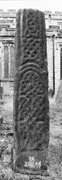
Object type: Part of shaft [1]
Measurements: H. 158 cm (62.25 in); W. 57 > 40 cm (22.5 > 15.75 in); D. 35 > 28 cm (13.75 > 11 in)
Stone type: Greyish orange pink (5YR 7/2), moderately sorted, clast-supported, quartz sandstone, with some fine (20 mm scale) cross bedding. The sub-angular to sub-rounded grains range from 0.2 to 0.7 mm across, but are dominantly medium grained in the range 0.3 to 0.4 mm. Interstitial pink to white barytes is present. Helsby Sandstone Formation, Sherwood Sandstone Group, Triassic (R.T. & C.R.B.)
Plate numbers in printed volume: Ills. 519–25
Corpus volume reference: Vol 13 p. 274-278
(There may be more views or larger images available for this item. Click on the thumbnail image to view.)
The shaft is bounded on all four edges by a plain wide angle roll moulding, which bifurcates half-way down its present length to form a double arched roll moulding that divides the decoration into two panels on all four faces.
A (broad): (i) Below the upper break in the stone, where the face is most worn, are the remains of three forward-facing figures wearing full-length robes, the skirts of which are described as a series of heavy parallel ribbed folds. Crossing each figure at waist-height are three horizontal, slightly curved mouldings. Above these on the central and left-hand figure are the worn remains of the torso; that on the left is marked by a deep incision. Below are three further figures. Their heads are rounded oval shapes, and the worn remains of eyes, nose and mouth can be discerned in the face of the central figure. The bodies of all three form discrete panels of interlace that follow the curve of the double arch containing the panel below. Their arms are arranged in such a way that it is unclear whether the two flanking figures have both arms upraised on either side of their heads, while those of the central figure emerge directly from the upper curve of the body to form a sharply inverted V, rising to meet the upraised arm of the flanking figure on each side, and then hanging down; or whether the outer arms of the flanking figures are upraised, while the other arm, much shorter, extends to meet the short arms of the central figure to grasp two short vertical rods held between them. This latter arrangement is suggested by the bulbous shape formed where the arms of the three figures meet.
(ii) In the lower panel below the arch are six further figures arranged in two rows of three, each having a rounded oval-shaped head; in all cases the remains of the deeply drilled eyes are clearly visible. The central figure in the upper row is slightly taller than those flanking it, the three figures thus following the line of the arch above. Their heads are surrounded by curved mouldings that spring from their deeply hunched shoulders. Small pellets are set in the interstices on either side of the central figure whose arms seem to hang down by his sides. The right arm of the figure on the right seems also to hang by his side, but he holds a short vertical rod in his left. The figure on the left seems to grasp the shoulder of the central figure with his right arm crossing his body, while his left hangs at his side. The bodies of all three are composed of discrete panels of interlace, those on each side forming an inverted U or bell-shape with that in the centre being more elongated. The heads of the three lowermost figures are similarly surrounded by mouldings rising from their deeply hunched shoulders. The carving is too worn to decipher whether the bodies were clothed, or described as panels of interlace. It is also impossible to tell whether their arms hung by their sides, but from what does remain it seems that this was unlikely.
B (narrow): The upper panel is filled with two registers of interlace set one above the other. That at the top, apparently forming a simple pattern E knot (Cramp 1991, fig. 23), is framed by two vertical plain inner roll mouldings; that below, which forms a closed-circuit pattern B squared ring-knot (ibid., fig. 24), extends the full width of the shaft, under the two inner mouldings above, and follows the shape of the double arched moulding below. On the right, the upper curve of the arch springs from a short band bridging the interstice between the lower arch and the outer roll moulding. Contained within the arched panel below, and following its shape at the top, is a continuous pattern of linked symmetrical Stafford knots (complete pattern E: ibid., fig. 14) that has been eroded at the base.
C (broad): (i) A pair of closed circuit pattern C spirals (Cramp 1991, fig. 24) fill the shaft above the double arched mouldings, although the upper one is largely lost in the break in the stone. Two twisted strands emerge from the lower edge of this spiral and cross into the centre of the spiral below. A pellet fills the interstices between the spirals. The centre of the lower spiral is filled with a series of three rings, and the two pairs of strands pass from these into the outer lower corners of the panel, joining in spear-shaped terminals. A pellet fills the interstices between these terminals and the outer curve of the spiral. (ii) Below the arched mouldings are the remains of three figures, that at the centre being slightly taller than the other two. Filling the space between their heads and the arch is an irregularly shaped panel of interlace that follows the outlines of the arch above and the heads below. All three figures have round heads, with indentations for the eyes still being visible. Their arms seem to have been upraised and joined together, being composed of a triple linked U-shape forming the shoulders and arms of each figure. The bodies below comprise discrete panels of interlace; the lower portions are too eroded to decipher whether feet were visible.
D (narrow): Above the double arched panel are the remains of a figure whose body is formed from a discrete panel of four-strand interlace contained within two thin vertical roll mouldings that terminate at the outer corners of the interlace. Two legs emerge from the interlace, flexed at the knees, with the feet turned out to follow the outline of the arch below. Above the feet are two prominent pellets. Below the arched mouldings is a panel of interlace formed from a series of symmetrically opposed Stafford knots that repeats the complete pattern E interlace found in the comparable position on B, with cross-joined terminals at the top.
This stone, along with Checkley 2 and 3, have attracted constant attention since they were first noted in the early antiquarian literature, and as a group have been generally described as marking the remains of ecclesiastics killed in battle by the Danes in the ninth century. This is unlikely given the style of the carving which bears little resemblance to other carvings of pre-Scandinavian production in Mercia and the West Midlands but, considered alongside other pieces in the region they do share features with the Scandinavian-period carvings preserved on the monumental shaft at Ilam (Ilam Estate 1, p. 293) with which they have been linked by their shared presentation of groups of figures with interlaced bodies (e.g. Browne 1887a; Plunkett 1984, 134–5).
Yet, apart from noting the local legend surrounding the monuments and the stylistic similarities they seems to share with Ilam, the decoration of Checkley 1 has been subjected to very little scholarly interrogation; Plunkett (1984) and Sidebottom (1994) provide some of the few recent and systematic studies of the stylistic features of the monument and its counterparts elsewhere in the region. In part this is due to the weathering Checkley 1 has sustained. But the repetition of groups of largely unidentifiable figures; the schematic rendition of their interlace bodies; the apparent lack of iconographic relationship between the groups of figures in the upper and lower panels on A and C; and the arrangement of the decoration, with its admix of figural and non-figural carving, all contribute to difficulties encountered in discussing the stone. Some observations are, nevertheless, possible.
The serried ranks of two to three figures, many of them haloed, is certainly a distinctive feature of the early to mid-ninth-century cross-shafts at Sandbach, Cheshire (Market Place 1 and 2), and the conjunction of interlace bodies (on A, C and D), moulded haloes (on A) and pellets (found on A and D) is a coincidence of details also found at Sandbach (see also Sandbach St Mary’s 1–5: Bailey 2010, 99–125; Hawkes 2002a, 137). While the pellets may well have originally been transposed onto stone monuments as skeuomorphs of metalwork rivets, in the later (late ninth-century) carvings at Sandbach they seem to have functioned as a stylistic leitmotif, which was reproduced elsewhere: in Derbyshire, at Hope (1), and in Staffordshire, at Alstonefield (2) and Leek (3).
Furthermore, the knots of interlace in the lower panels of Checkley 1B and D can be paralleled on Hope 1 and Norbury 1 and 2 in Derbyshire, and elsewhere in Staffordshire on Alstonefield 2, Ilam 1 and Ilam Estate 1 (Plunkett 1984, 138–9). They are also arranged so as to display cross shapes in the spaces between the knots. This is a detail found widely across Anglo-Saxon England in various media, including sculpture (Stevenson 1981–2; Hawkes 1997c, 328–34; Webster 2003b; Hawkes 2005, 269–71, fig. 17.7), and implies that considerable planning was invested in the layout of the decoration. It is an observation that seems to be supported by the way the block of thin ‘ribbon’ interlace on 1B stands on the square knot of thicker interlace in the upper panel of 1B, suggesting the decoration may have comprised a series of knots which become thinner as they proceed up the length of the shaft.
As far as the figures are concerned, it is not clear that any symbolic significance was intended, although the three on 1C are posed in the orans stance of prayer, with their arms upraised on either side of their heads, suggesting some form of Christian frame of reference. The ‘canopy’ over their heads may also point to such frames of reference, as has been argued for stylised wings that form canopies over enthroned figures from early Christian art in Rome (Malbon 1990, pl. 44) to eighth- and ninth-century sculpture in the Insular world (Stalley 1990, 143–5; Hawkes 2005, 268). However, none of these explanations provides a convincing analogy with the interlaced shape set over the heads of the orants on 1C; here it is more likely that the iconographic function of outspread wings was being invoked: namely, the overarching vault of the heavens, perhaps represented architecturally by the vault of an apse in the prototype lying behind the Checkley group. Although highly stylised and abstracted, reduced to patterned shapes and forms, it is not impossible that the figural panel on 1C can be understood as depicting three figures in prayer under a vault which may indicate the heavens, or the arched vault of a building–suggesting a Christian frame of reference, and possible ecclesiastical patronage.
The figures on 1A seem to have been arranged as two panels of six. However, given the incomplete nature of the shaft, this numbering of twelve may be coincidental rather than iconographically significant. Furthermore, while all the figures currently discernible are (apart from those in the upper panel on A) highly patterned with their interlacing robes, and badly worn, they do, nevertheless, conform to a common figure type characterised by a long (interlaced) robe with discrete heads and arms, and where not cut away by the ‘haloes’ or lower frame of the panel, the legs are also clearly defined. More distinctive are the remains of the uppermost figures on 1A: the vertical ribs and horizontal mouldings resemble long garments of early Christian type which were reproduced elsewhere in Anglo-Saxon sculpture, most notably on the late eighth-century sarcophagus cover at Wirksworth (5), where the figures wear full-length heavily pleated robes tied at the waist by a wide band, depicted as a series of horizontal mouldings (Ills. 446-55). This provides the most convincing explanation for the carving at the top of Checkley 1A (and the worn figures on Checkley 2A). It seems that the figural decoration of 1A consisted of at least two panels, one of which contained six figures with interlaced robes, while the other contained three figures with interlaced robes, and three with full-length pleated garments that reflect an early Christian prototype depicting such clothing.
This does not immediately clarify the potential identity and significance of the figural schemes. Clearly too little remains of the upper row to decipher anything about them other than their garments and number: only the figure on the upper right seems to have held their right arm across their lower body. The three figures in the lower row, however, seem to have their arms upraised in the orans pose, like those on 1C, but they also seem, collectively, to grasp rods on either side of the central figure. This is the only aspect of the scheme that marks this figure out; in the panel below, the central upper figure is also distinguished from those flanking him–by his taller proportions and the pellets set on either side of his head. These figures are further distinguished by having stylised haloes surrounding their heads, implying an intended portrayal of six figures with Christian significance. The taller proportions of the central uppermost figure, and the way he is otherwise distinguished might further suggest that he can be identified with Christ, who is similarly distinguished at Sandbach (Market Square 1 and 2): in the Transfiguration schemes where he is flanked by Moses and Isaiah; in the Traditio Legis cum Clavis where he is flanked by Peter and Paul; and in the Adoration where he is flanked by two unidentifiable figures (Bailey 2010, 99–120; see Ill. 643).
If the Traditio Legis or Adoration schemes were intended at Checkley it is hard to explain the lower group of three figures, but if the Transfiguration was intended it might have depicted the disciples Peter, John and James, witnesses to the event. This, however, seems unlikely as no motif survives at Checkley which might signify the Holy Spirit or Voice of God: at Sandbach this was depicted by the bird over Christ’s shoulder (Hawkes 2002a, 49–56, 109–10; Bailey 2010, 99–120). There is, furthermore, no explanation within the context of a Transfiguration scene for the figure on the left grasping the shoulder of that in the centre, nor for the short rod held out to one side by the right-hand figure. Further arguing against the likelihood of a Transfiguration scheme is the absence of any indication that the six figures in the panel should be considered as together forming a single scheme, especially as series of figures set one above the other in early medieval art can depict different iconographic schemes. On the late eighth-century Enger reliquary, for instance, the Adoration of the Virgin and Child is set immediately below that of the Adoration of Christ, while at Sandbach a similar organisation of schemes was depicted in the ninth century on Market Square 2 (Hawkes 2002a, 112–13, fig. 3.15; Bailey 2010, 113–20). In these instances, the figures are isolated in individual niches, while at Checkley they are grouped together, and separated as groups only by the undulating lines of the haloes surrounding the heads of the lower row of figures, and by the prominent verticals of their arms and/or sides of their bodies.
There are also indications that the upper row of three figures was intended to be treated as a single entity: in the way that the left-hand figure grasps the shoulder of that in the centre. This, and the attribute held by the figure on the right, suggest that the group might be identified depicting one of the events surrounding the Arrest of Christ. In the ninth century, this took various forms with Christ being flanked by Judas (who has one hand extended towards him) with another figure standing by–the betrayal being accompanied by the depiction of Peter wielding a sword and cutting off Malchus’ ear (Harbison 1992, iii, pl. 876). Alternatively, the three-figure group including Judas could be accompanied by the depiction of the arrest, with Christ standing centrally (and taller) flanked by an arresting soldier who has one arm extended towards his shoulder, and a second figure–who could be identified with Malchus or Peter standing with his sword on the far right (Schiller 1972, pl. 166). Also associated with images of these events is the Mocking of Christ, which features Christ standing with both arms held at his side and grasped by the two figures flanking him. In earlier versions of these events the figures are even more closely united, as in the early sixth-century mosaics of Sant’Apollinare Nuovo (Ill. 658), the late sixth-century Rabbula Gospels (Florence, Bibl. Laurenziana, Cod. Plut. I. 56, fol. 12r), and Augustine Gospels (Cambridge, Corpus Christi College, MS 286, fol. 125r): Schiller 1972, pls. 158–9, 161. In each of these schemes, produced under the strong influence of eastern Mediterranean iconographic types before their appearance in Carolingian art in the ninth century, the events preceding the Crucifixion involve groups of three figures focused on Christ, with one or both of the flanking figures extending their arms towards him and holding an object such as a long thin torch or a sword.
These are all elements repeated in the schemes at Checkley, in the upper and lower panels, and they are reproduced elsewhere in the Insular world in Ireland, on the ninth- or tenth-century Cross of Muirdach at Monasterboice, Co. Louth, where the Mocking is illustrated by Christ, centrally placed, grasping a rod/reed out to one side, his other arm upraised and grasped by a sword-bearing soldier; another similarly equipped soldier extends his arm towards Christ on the left (Harbison 1992, cat. 174, fig. 480). At Castledermot (Co. Kildare), however, the event is depicted by means of the two flanking figures extending their arms towards Christ in the centre, both holding short rods/reeds (Harbison 1992, cat. 37, fig. 110), while at Arboe (Co. Tyrone) and Drumcliff (Co. Sligo), on cross-shafts dating to the tenth century, portrayals of the Mocking form a three-figured group of standing figures, who are generally unidentifiable from each other in their current condition, and whose arms are linked together across the panel (Harbison 1992, 79, 81, cat. 8, figs. 31, 220, 228: see Ill. 659): as in the so-called ‘Arrest of Christ’ in the c. 800 Book of Kells (Dublin, Trinity College MS A. I. 6, fol. 114r). On ninth-century ivories of Carolingian provenance, this central grouping forms part of more extended narrative images involving a group of soldiers who look on, mocking (Harbison 1992, iii, figs. 876–7). These general images, illustrating various closely linked episodes in the time leading up to the Crucifixion, provide examples of a series of figural arrangements that resemble the schemes on Checkley 1.
Thus, although much is unrecoverable, sufficient remains to suggest that the figural carving of Checkley 1 reflects a later response to visual traditions evolving from those established earlier, in the pre-Viking sculpture of the West Midlands area, such as that preserved at Sandbach in the first half of the ninth century. The intended significance of the Checkley schemes remains difficult to reconstruct given the schematic presentation of the figures, but reference to the general theme of Salvation is not impossible, given the repetition of the orans figures and the possible vaulting on 1C, while the potential Betrayal, Arrest or Mocking of Christ on 1A would point to an iconographic reference to the salvation made possible through Christ’s Passion.
