Select a site alphabetically from the choices shown in the box below. Alternatively, browse sculptural examples using the Forward/Back buttons.
Chapters for this volume, along with copies of original in-text images, are available here.


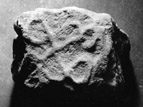
Object type: Part of cross-arm
Measurements: H. 32 cm (12.5 in); W. 37 cm (14.5 in); D. 23 cm (9 in)
Stone type: Greyish pink (5R 8/2), poorly sorted, clast-supported feldspathic quartz sandstone. The sub-angular to sub-rounded grains vary from 0.4 to 1.5 mm, but are mostly in the range 0.5–0.8 mm. Millstone Grit Group, Carboniferous (C.R.B.)
Plate numbers in printed volume: Ills. 118–22
Corpus volume reference: Vol 13 p. 153-155
(There may be more views or larger images available for this item. Click on the thumbnail image to view.)
The carving on A, B and F was originally contained by plain flat angle mouldings that survive in a fragmentary condition.
A (broad): Within the frame partially formed by the angle mouldings is the figure of a half-length angel, slightly turned to the left to face what would originally have been the centre of the cross-head. He has short hair and deeply drilled eyes, and well-modelled cheeks, mouth and chin. His clothing forms a series of heavy pleats that fall from his shoulders and terminate in deep folds above the lower frame. Wings, rising sharply behind his shoulders, are outlined by a thin continuous roll moulding; that on his left falls in three parallel ribs flanking his torso. With his left hand, emerging from the folds of his robes, he supports a ‘trumpet’ that extends horizontally from his mouth to the left, to pass behind a floriated rod held in his right hand such that its terminal obscures the wing on his right.
B (end of cross-arm): The carving consists of an angel facing forwards. The head has been sheared off, but the outline survives. The remnants of a wing, outlined by a thin curved moulding, survive over his right shoulder, falling as a series of parallel ribs down his side. He wears a heavily pleated over-garment that is wrapped round his shoulders and cascades over his right arm. In both hands, the right emerging from his robes, he holds a staff at a slight angle across the left side of his body. This originally extended over his left shoulder but it has been lost in the damage to the upper left-hand corner of the panel.
C (broad): Worn and broken. No carving remains.
D (junction with centre of cross-head): Broken
E (top of cross-arm): The carved decoration consists of a simple, single-strand loose knot. There is no indication of a containing frame.
F (underside of cross-arm): The decoration contained by the angle moulding consists of a well-executed knot set out on a square grid (Cramp 1991, xxix) To the left, the spandrel of the arm is marked by a plain flat moulding framing a plain dressed panel.
The interlace patterns decorating E and F, as well as the figural style used on A and B link this piece to the centre responsible for Bakewell 1 and 32, as well as Eyam 1 and Bradbourne 1 and 5 (see Chapter VI). The inclusion of an angel blowing a trumpet on A, and another holding a staff across his shoulder on the end of the cross-arm (B), further links the piece to the iconographic scheme displayed on the cross-head of Eyam 1 where angels with trumpets fill the cross-arms of 1C and an angel with a staff fills the end of a cross-arm (1B) (Ills. 206, 207). The survival of a portion of another staff-bearing angel from the central medallion of a cross-head (Bradbourne 5) indicates that these iconographic similarities may have been extensive; Eyam 1 depicts such figures in the central medallions of both the main faces of the cross-head (1A and 1C). If Bradbourne 4 (and 5) can be associated with Bradbourne 1, the iconographic programme of the cross-head, depicting angels with trumpets and staffs, has significant implications for our understanding of the overall iconographic programme of the cross once standing at the site.
Certainly, the cross-head itself can be considered in the light of ideas surrounding angels in Anglo-Saxon England during the seventh to ninth centuries, a period when they were regarded as figures of contemplation in fellowship with humanity, a fellowship founded on the sharing of free will (Gregory I, In Hiezech. I, Hom.viii.18, Adriaen 1971, 110; Hawkes 2005, 268–9; id. 2007a, 438–42; although see Sowerby 2016). In a liturgical context this was reflected in the understanding that angels were the colleagues of men in prayer and present at the canonical hours (e.g. Bede, Hom. 10. Post Pascha: Lk. xxiv, 1–9, Hurst and Fraipont 1955, 248–50; Mayr-Harting 1998, 14). Underpinning such attitudes was the understanding that contemplation of the divine (that which linked humanity with the angelic), was the process crucial to integrating the inner life with the active; it was thus critical in effecting the pastoral life of the priesthood (Gregory I, In Hiezech. I, Hom. viii. 12–16, in Adriaen 1971, 107–9; Bede, De Tab. II. 9, in Hurst 1969, 73-5; Thacker 1983, 152–3; O’Reilly 1995, xxvi–xli; Markus 1997, 21–47). Angels therefore, were regarded as creatures that could be identified both with the heavenly and the human in prayer and contemplation. In fact, contemplation was what made the Church of the Christian community ‘as like to the angels’ (Gregory I, In Hiezech. I, Hom. viii. 6, in Adriaen 1971, 104–5; Sowerby 2012, 55–6).
Set in the head of the Bradbourne cross, angelic figures could thus be understood to have acted as mnemonics inviting the viewer to consider the link between men and angels and their shared obligation of rightful contemplation of the godhead, such contemplation being a necessary precondition of proper understanding and the exercise of right action–particularly for the priesthood—subjects that could well be signified by the archers and plant-scroll filling Bradbourne 1B and 1D, the elucidation of which Gregory the Great, depicted at the base of Bradbourne 1C (Ill. 113), was particularly celebrated in Anglo-Saxon England between the eighth and ninth centuries.
