Select a site alphabetically from the choices shown in the box below. Alternatively, browse sculptural examples using the Forward/Back buttons.
Chapters for this volume, along with copies of original in-text images, are available here.


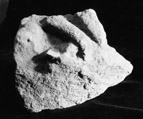
Object type: Part of cross-head
Measurements: H. 22 cm (8.6 in); W. 28 cm (11 in); D. 13 cm (5.1 in)
Stone type: Very pale orange (10YR 8/2), poorly sorted, clast-supported, feldspathic quartz sandstone. The sub-angular to sub-rounded clasts vary from 0.3 to 0.7 mm, but are mostly in the range 0.4 to 0.5 mm. Millstone Grit Group, Carboniferous (C.R.B.)
Plate numbers in printed volume: Ills. 124–5; Fig. 40
Corpus volume reference: Vol 13 p. 155-156
(There may be more views or larger images available for this item. Click on the thumbnail image to view.)
A (broad): The remains of two intersecting sections of roll moulding survive, the lower one of which contains the remains of the head of a human figure with short hair and deeply drilled eyes. To the right are the remnants of the terminal of a floriated rod.
B (narrow): upper spandrel. Only the fragmentary remains of a section of roll moulding facing onto A survives.
C (broad) and D (narrow): Broken
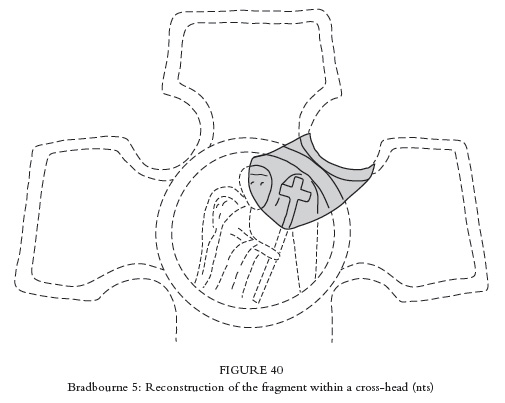
The carved remains of this small fragment are sufficient to have allowed for its reconstruction (Fig. 40) as a section from the upper right-hand quadrant of the central medallion of a cross-head, containing a portion of an angel’s wing on the left, and the floriate terminal of a staff held over the angel’s shoulder, in the space between the wing and the moulding enclosing the panel (Moreland 2010, 273-4, fig. on 273). It thus bears a remarkable similarity, iconographically, to the central medallions of the Eyam cross-head (1A and 1C) which contain staff-bearing angels (Ills. 204, 206). If, as seems likely, it represents a fragment of the cross-head that once surmounted Bradbourne 1, and can be related to the cross-arm that also survives at Bradbourne (no. 4)—a supposition not contradicted by the stone type—it thus extends our understanding of the potential iconographic programme of that cross-head, and the way it replicates that preserved at Eyam (see Bradbourne 4).
