Select a site alphabetically from the choices shown in the box below. Alternatively, browse sculptural examples using the Forward/Back buttons.
Chapters for this volume, along with copies of original in-text images, are available here.


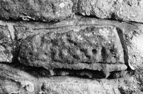
Object type: Part of shaft with lower part of cross-head
Measurements: H. 19.5 cm (7.75 in); W. 35 cm (13.75 in); D. unknown
Stone type: Pale red (10R 6/2), moderately sorted, clast-supported, feldspathic quartz sandstone. The sub-angular to sub-rounded clasts vary from 0.3 to 0.7 mm, but are dominantly between 0.5 and 0.6 mm across. Ashover Grit Member?, Marsden Formation, Millstone Grit Group, Carboniferous (C.R.B.)
Plate numbers in printed volume: Ill. 123
Corpus volume reference: Vol 13 p. 152-153
(There may be more views or larger images available for this item. Click on the thumbnail image to view.)
A (broad): A thin horizontal roll moulding separates a panel of worn interlace from what appears to be the vestiges of a further panel, framed by two plain mouldings contiguous with the horizontal moulding. The carved remains of this panel consist only of two slightly curved pieces of carving in deep relief.
B and D (narrow) and C (broad): Inaccessible
The fragmentary and worn condition of the stone limit understanding of its decorative scheme and original function. Nevertheless, the presence of a panel of interlace in conjunction with what may have been figural ornament distinguish it from the more extensive schemes surviving elsewhere at Bradbourne. On no. 1, for instance, figural panels on the broad faces, are offset by continuous plant-scroll motifs on the narrower faces, while the decoration of the surviving cross-head fragments (nos. 4 and 5), is limited to figural ornament. Nowhere is there any indication of panels of interlace on these stones. No. 3 does present a panel of interlace but this is contained by wide flat angle mouldings, and comprises a wide-banded simple two-strand pattern. Here, the panel of interlace is a fine, multi-stranded pattern. This may suggest that Bradbourne 2 represents the remains of a further sculptural monument from the site (see no. 3). However, the use of the shared stone type, the width of the stone which, although incomplete, is not inconsistent with the dimensions of Bradbourne 1D and 1B, and the narrow roll mouldings which compare with those on 1A and 1C, together imply that, if not part of the same monument, Bradbourne 2 is, in all likelihood, contemporary with Bradbourne 1.
