Select a site alphabetically from the choices shown in the box below. Alternatively, browse sculptural examples using the Forward/Back buttons.
Chapters for this volume, along with copies of original in-text images, are available here.


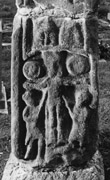
Object type: Remains of cross-shaft
Measurements:
H. Overall 225 cm (88.6 in); Upper stone 131 cm (55.5 in); Lower stone 96 cm (37.75 in)
W. Upper stone 46 > 42 cm (18.1 > 16.5 in); Lower stone 52 > 50 cm (20.5 > 19.6 in)
D. Upper stone 34 > 33 cm (13.3 > 13 in); Lower stone 43 cm (17 in)
Stone type: Pale red (10R 6/2), moderately sorted, clast-supported, feldspathic quartz sandstone. The sub-angular to sub-rounded clasts vary from 0.3 to 1.2 mm, but are dominantly between 0.5 and 0.7 mm across. Ashover Grit Member?, Marsden Formation, Millstone Grit Group, Carboniferous (R.T. & C.R.B.)
Plate numbers in printed volume: Ills. 109–14; Fig. 4b–c
Corpus volume reference: Vol 13 p. 147-152
(There may be more views or larger images available for this item. Click on the thumbnail image to view.)
The shaft was originally bounded on each face by a plain flat vertical angle moulding, worn and damaged on A and D, which was inset on A and C with slightly narrower plain roll mouldings.
A (broad): The angle moulding is complete on the left, but fragmentary on the right of the lower stone and at the top of the upper stone. The panels, except that at the base of the shaft, are defined by horizontal mouldings contiguous with the inner vertical mouldings; that over the top of the lowermost panel is slightly arched. (i) The remains of the uppermost panel are extremely worn. The remains of a human figure are visible in the top left: the outlines of the head and shoulders can be discerned. To the right and apparently crossing the body of this figure at a slight angle, are the remains of a staff that seems to have a slightly bulbous terminal. On the right of the panel are the remains of a second figure: the outline mirrors that of the shoulders of the figure on the left. It is possible that this pair of figures stood on a slightly curved moulding extending from the inner vertical mouldings. Centrally placed, and extending over the lower portion of this uppermost pair of figures, are the worn remains of a human head; the body, apparently clothed in a full-length robe, is still visible standing with the feet centrally placed on the horizontal moulding dividing the panel from that below. On a plane slightly behind this figure is a large flat ‘block’, whose upper edge extends horizontally across the panel at the level of the shoulders. (ii) The panel below seems also to have contained two standing figures; the outlines of the heads and shoulders of both can be discerned. The figure on the left seems to have been half turned to the centre, with the right arm bent at the elbow across the body. A slightly rounded feature obtrudes into the space between the heads; it is suggestive of the head of a smaller figure set between them. The carving below this area, however, is too worn to discern any sign of the body of either this putative figure, or indeed, that on the right. (iii) Below the horizontal moulding surviving under the left-hand figure, the carving is too damaged to decipher. The remains consist of a large feature, with a curved outline on the left, which seems to have filled the entire panel. The lower part of the panel is slightly honeycombed, but it is unclear whether this is due to wear sustained by the original carving, or subsequent damage. (iv) Below the break between the two portions of the shaft, and resting on the upper edge of the curved arched moulding, seem to be the remains of two three-quarter-length figures. That on the left apparently held a thin staff; the hands can be discerned clasping it at chest-height. (v) The lower-most panel is filled with the remains of a Crucifixion scene. The field is filled and quartered by the cross bearing the figure of Christ whose arms are slightly flexed at the elbows, but whose hands do not ‘droop’. A hole, drilled into the centre of the right palm, is clearly visible. The head of the crucified figure seems to have been short-haired and faces strictly forwards; the eyes being deeply drilled. The body stands stiffly upright and the legs are well modelled and naked, indicating that Christ originally wore a brief loincloth, the outlines of which can be discerned in certain lighting across the waist and the upper part of the right leg. The feet hang side-by-side as two conical shapes and bear the remains of drilled holes placed centrally in each. Below these the cross-arm widens slightly; the remains of a circular cavity fills the base but it is unclear whether this is the result of damage to the stone at this point. The portion of the cross above the head of the crucified figure is plain and the upper quadrants of the panel are filled with large, modelled discs. That on the right contains the remains of a head in profile, facing the centre, while the other bears a crescent in high relief. The lower quadrants are filled with two full-length figures wearing short robes whose hems are visible behind the legs. The bodies are three-quarter turned towards the centre, while their faces turn outwards to face the spectator; both had short hair and their eyes are deeply drilled. The figure on the left holds a long staff diagonally across his body, his right hand holding it at waist height, his left arm visible and extended up ‘behind’ it. The lower end of the staff terminates just below the hem of his tunic; the upper end terminates at the right-hand side of the crucified figure, just below the right arm. The legs of this flanking figure are flexed, supporting the weight of the upward thrusting motion of the body; it is a posture mirrored by that of the figure on the right, although the legs of this figure are lost in the damage to the stone. The staff held by this figure extends across the chest of the crucified figure, and in certain lights, seems to terminate in a slightly bulbous shape over the left shoulder. As the carving is slightly damaged at this point this detail cannot be ascertained.
B (narrow): The length of the shaft is filled with a plant-scroll emerging from behind the figure of an archer positioned diagonally above the lowermost edge of the stone. His body is three-quarter turned, but his head, with short hair, is turned out to face the spectator. He wears a short tunic. One leg is sharply bent under the bow that he holds before him, such that his foot rests against the shin of his other leg which extends into the lower right-hand corner of the shaft. The right arm is extended across the body to hold the outer frame of the bow. Damage to the stone means it is unclear whether the other arm also held the bow (as is the case on D), or whether, as is more likely, the slightly narrower feature extending diagonally across the bow represents the remains of the arrow. The central stem of the plant-scroll that fills the remainder of the shaft emerges from behind the bow. In the lower portion of the stem the branches growing from either side scroll twice before crossing over and under it to terminate (in some cases in a spear-shaped leaf) in the interstices between the scrolls. This pattern seems to have been continued in the upper portion of the shaft, although the scrolls are only visible on the left just above the break in the stone. About half-way up the length of the upper portion, on the right, the pattern is broken by the presence of a profile quadruped arranged so that its back follows the outer edge of the shaft with its tail apparently merging into the scroll below it. The head, lowered towards a branch that runs vertically up the shaft, originally to the right of the central stem, is turned to face the spectator; the eyes are deeply drilled. All four legs are visible (those on the far side being coherently rendered below the body), resting on the vertical branch that terminates in a spray of berries above. Above this are the remains of the lower half of a profile human figure wearing a full-length robe standing on a branch emerging from the central stem, with the feet turned to the centre. The upper part of the figure is lost in the break in the stone.
C (broad): The carving is contained within slightly arched panels formed by mouldings springing from the inner roll mouldings on each side. (i) The uppermost panel contains the remains of two figures. The head of that on the right survives, facing forwards with short hair, and is deeply set on the shoulders that are swathed in the heavily pleated robes. These are arranged such that heavy folds hang down each side of the figure, and a further series cross the centre of the body. Although the head and shoulders of the figure on the left have been lost in damage to the upper part of the stone, it seems to have been similarly clothed. The lower part of both figures is cut off by the arched moulding separating them from the panel below. (ii) This too contains the remains of two figures; the carving is so worn however, it is impossible to determine whether they were three-quarter length, with a further panel below, or full-length. The outline of the heads is clearly visible, as is that of the shoulders of the figure on the left which replicates that of the figure on the right in the panel above, suggesting that these figures also wore heavily pleated robes that swathed their bodies. While the damage does obscure the details, it appears that the figure on the right may have been placed slightly in front of that on the left. (iii) Below the break in the stone are the remains of two further figures. Only the very lower parts of their robes remain, cut off by the arched moulding dividing them from the panel below. (iv) This contains two half-length figures whose heads face forwards, have short hair and deeply drilled eyes. Like the figures in the upper-most panel their heads are set deeply on their shoulders, with heavy folds of drapery around their shoulders. The hands of the figure on the right emerge from its robes and are held, one above the other, across the chest. Heavy folds of an over-garment fall down either side of the body and pleats of an under-garment are gathered horizontally across the body. The same arrangement seems to be repeated for the figure on the left, although the central part of the body is more worn, making the details less easy to decipher; in some lights it appears that this figure may have held a book. The lower part of both figures is cut off by the arched moulding separating the panel from that below. (v) The lowermost panel is filled with three human figures, with the largest, centrally placed, dominating the group. He faces forwards, has short hair and deeply drilled eyes. His robes replicate those worn by the figures above, being gathered in folds around his shoulders. His arms, swathed in the over-garment, are held out from his body and bent at the elbows, so that the hands, emerging from the drapery, hold a large square object in front of his chest that rests on a T-shaped stand set before him. A rectangular object is set at a slight angle under the arched frame over his left shoulder. A bird perches on his right shoulder, its beak extending towards his head. Under this figure’s elbows are the heads of two diminutive figures that face the centre; their shoulders are lost in the break at the base of the stone but they appear to lean towards the centre over indistinguishable features.
D (narrow): The angle moulding has been lost in the damage to the upper portion of the shaft on the left, but it originally contained a stylised plant-scroll with the remains of an archer with his bow and arrow at the base. The bow, held in both hands, survives intact. The archer’s arms extend across the bow-string to grip the bow itself; the arrow, with its point centred on the bow, is visible between them. The right arm extends to the lower break in the stone, the shoulder, and what may be the worn remains of the head, being visible just above the break. To the right are the remains of the archer’s bent knee, with a spear-shaped cluster of berries on the far right. The plant-scroll seems to have originated to the left of the bowman. From this point it is arranged diagonally across the field of the lower part of the shaft, with two scrolls branching out alternately right and left, the interstice of the spirals on the right being filled with two stems that cross each other and terminate in spear-shaped leaves. The centre of the lowermost spiral is filled only with plant-stems, one of which emerges to cross the outer spiral and terminate in a spear-shaped leaf that fills the space below it, above and to the right of the bow. The upper spiral, although worn, seems to have been filled with a single leaf; a stem emerges from the centre to cross the outer spiral and fill the interstice with two spear-shaped leaves that double back towards the spiral, and a third that hangs down to the main stem. This pattern seems to be repeated below the break in the stone, with the crossed double-stems filling the interstice of the spiral on the left. Above the break, the carving on the left is too worn to decipher, although the remains of a spiral with a crossing stem can be discerned on the lower left. On the right, the damage running through the centre of the shaft obscures much of the carving, but the remains of spirals interspersed with spear-shaped leaves can still be seen.
Like Bakewell 1, the plant-scroll and figural style of this monument have been the subject of scholarly attention in discussions that have demonstrated the links between the two monuments and Eyam 1 (see Chapter VI; Bakewell 1, p. 108). In addition to these stylistic links, however, a number of iconographic features are also repeated at Bradbourne, albeit with different arrangements from those preserved at Bakewell and Eyam. If the surviving cross-arm (Bradbourne 4) and fragment of cross-head (Bradbourne 5) can be associated with this shaft, the angel with a trumpet (on no. 4), and those with floriated staffs (on nos. 4 and 5), would serve as an iconographic link with Eyam 1, while the Crucifixion, and the archers set in a plant-scroll, which on B also contains a quadruped in its upper reaches, are features shared by Bakewell 1.
The presence of the archers on B and D, and the quadruped and figure on B, indicates that, although the type of plant-scroll depicted varies from that featured on Bakewell 1, the intended iconographic significance of the scheme is probably the same. At Bakewell the most likely references lie in the exegetical tradition associated with Psalm 119/120: 4 which regarded the ‘sharp arrows of the mighty’ as signifying the word of God shot from the bow of the preacher. At Bradbourne this interpretation is consistent with the setting of the plant-scroll, which can be understood to signify various inter-related themes concerning Christ, ‘the true vine’ (John 15: 1), the Church founded in Christ, the Eucharist and participation in that mystery (see e.g. Hawkes 2003b, 359–61; 2003c, 276–9). The quadruped and figure preserved in the upper scrolls of B can further be seen to signify those receiving spiritual sustenance from the Church, the sacraments and the word of God.
The exceedingly worn condition of much of the carving on A and C has meant that, with the exception of the Crucifixion preserved at the base of 1A (Coatsworth 1979, 196–8), the iconography of the figural panels has been largely ignored. Indeed, only the most general of impressions survives of panels of paired figures interspersed with other designs on the upper part of A. So general are these impressions that the panels’ subject-matter cannot be identified. The Crucifixion, however, is clear (Ill. 110), and the details are sufficiently well preserved to identify the loincloth-type of Christ accompanied by Longinus and Stephaton (also featured at Bakewell 1), with enlarged symbols of the sun and moon in the upper spandrels of the cross. The lower portions of the panel have been lost, so it is impossible to tell whether the cross was inserted into the mound of Golgotha as at Bakewell, and although it might be tempting to interpret the cavity at the base of the cross as the grave sometimes depicted below the cross containing the head of Adam (as in the ninth-century Gospel Book at Angers; Schiller 1972, fig. 390: see Ill. 639), this is unlikely as Adam was generally set under the cross, rather than within the confines of the lower cross-arm. Indeed, the cavity may well represent secondary damage to the stone rather than comprising an original iconographic feature.
Despite the loss of the lower portions of the panel, however, sufficient details remain to indicate that the scene, if derived from the same model as that depicted at Bakewell, was adapted. The deeply drilled holes piercing Christ’s right hand and feet at Bradbourne are absent from Bakewell (Ill. 6). Their presence at Bradbourne, and the possibility that they were originally filled with metal insets, along with the fact that the panel was situated at or near the base of the shaft, suggest the deliberate intention on the part of those responsible for the production of the shaft, to emphasise Christ’s humanity at the Crucifixion, his suffering, and the redemptive nature of the event in keeping with attitudes surrounding the event during the course of the ninth century (Chazelle 2001, 85–95).
These attitudes, however, were also concerned to highlight Christ’s divinity, and it was this that resulted in the re-introduction and prominence given to the symbols of the sun and moon included in depictions of the Crucifixion: an early ninth-century ivory now at Narbonne (Schiller 1972, fig. 368), for instance, includes the personifications of the sun and moon within large circular discs. While these sometimes refer to the darkness that fell over the face of the earth at the ninth hour (Schiller 1972, 109), their presence was more usually intended to symbolise the cosmic nature of Christ’s divine sovereignty, and in Carolingian art they were used as ‘heavenly’ witnesses to the divinity that made possible the victory over death and the resurrection of the dead (Schiller 1972, 109; Chazelle 2001, 277). Their prominence in the Bradbourne scene, along with that given to the nails piercing Christ’s hands and feet, all point to the influence of such images and the liturgical responses lying behind them that were current from the early ninth century onwards.
The details of the panels that once filled the upper part of 1C, like those of A, have been largely lost, but the paired, short-haired, heavily swathed figures surviving towards the top of the lower stone on C (Ill. 113) can be identified as clerical figures wearing pallia, one of whom may hold a book. The way the worn outlines of the figures in the panels above replicate this general arrangement implies that a scheme consisting of paired ecclesiastics was repeated the full length of the shaft, suggesting the original existence of at least four such pairs.
The lowermost panel (Ill. 113), however, interrupts this pattern with its depiction of a centrally placed short-haired male figure, with a bird and rectangular object over his shoulders, who rests a book on what is probably a lectern, and is flanked by two diminutive figures set in a plane before him. These elements and their overall arrangement allow this image to be identified as Gregory the Great in his role as Scribe. While portraits of Gregory as Pope survive from an early date, it was only during the ninth century that an iconographic scheme emerged that depicted him writing and in the company of fellow scribes who vary in number between one and three (e.g. ninth-century ivory now in Vienna: Goldschmidt 1914, Taf. LIV.122). It is in this iconographic context that Gregory is associated with the bird, and sometimes with an open manuscript in the upper confines of the surrounding frame–a detail suggesting the identity of the rectangular object over the left shoulder of the Bradbourne figure (e.g. tenth-century copy of Gregory’s Homilies on Ezekiel, Einseiedeln, Stiftsbibl. MS 156, p.11: Princeton Index, 32/ Ei67/ LSts/ 11,2).
Although the portrayal of Gregory as Scribe is identified with Carolingian innovations, the association of his scribal activities with the dove of the Holy Spirit inspiring his work (on Ezekiel), has an earlier, eighth-century Anglo-Saxon literary source, being preserved in the Whitby Life of Gregory (Colgrave 1968), where it is explained that his status as an author both elevated him to inclusion among scribes who bring forth from Christ’s treasure ‘things new and old’, and allowed one of his companions to see a dove resting on his shoulder ‘while he was engaged in writing these homilies on Ezekiel’ (V.Greg. 25-6; Colgrave 1968, 120-3; Hawkes 2007a, 445–8). The preservation of this episode in an Anglo-Saxon context may well explain the portrayal of Gregory as Scribe at Bradbourne, particularly as copies of the Whitby Life are thought to have been circulating in Mercia from the eighth century (Colgrave 1968, 155, n.99, 160, n.120; Thacker 1998). Furthermore, the arrangement of the scheme itself is constructed within the long-established aulic tradition of the hieratic central figure surrounded by diminutive subsidiary figures; this is an iconographic tradition used elsewhere in Mercian art in the eighth century to create scenes such as David Dictating the Psalms in the Vespasian Psalter (London, British Library Cotton Vespasian A.I, fol. 30v: Alexander 1978, fig. 146).
The importance with which Gregory was regarded in Anglo-Saxon England goes some way towards explaining both the depiction of him at Bradbourne and the potential iconographic programme once presented by the monument. In the Whitby Life, it is Gregory’s homilies on Ezekiel that are presented as among the most celebrated of his works, but the account that is given of these homilies summarises only the eighth homily of the first book: that which was most concerned with the role of contemplating the divine, the importance of preaching in inspiring contemplation, and its function in the Christian life. This is not to say that the Bradbourne monument functioned as a visual commentary inspired by the Life of Gregory. Rather, it suggests that those responsible for its production sought to convey the importance Gregory placed on the act of contemplation within the active pastoral life of the Church. This was expressed by juxtaposing Gregory with a series of clerical figures; as well as the schemes of archers and plant-scrolls filling the narrow sides of the shaft with their potential references to preaching and spiritual salvation available through the Church; and the Crucifixion with its emphasis on the divine and human nature of Christ and his redemption, themes that were increasingly emphasised liturgically and textually during the course of the ninth century.
[1] Allen and Browne's (1885, 355) reference to two cross-shafts being in the churchyard at Bradbourne appears to be a misreading of Bateman (1848, 194). Eeles (1941, 1) also mentions 'crosses' in the churchyard, but this is either a continuation of that tradition, or it reflects an acceptance of Routh (1937a, 19; 1937b, 21–2) who argues that, despite Browne's 1886 experimental reconstruction, the fragments came from two separate monuments because he thought he could see a crucifixion on the upper portion of the stile fragments; he later retracted this argument ((—) 1947).
[2] This use of the stone is confirmed by the two holes surviving on one side (B) of the current lower stone of the shaft in the churchyard.
[3]Moreland (1999, 205), citing Glover (1833, 154), considers that the piece had been moved into the churchyard by 1833. However, Glover's (1833, 133) reference to the lower part of the shaft repeats his earlier description (Glover and Noble 1829, II, 133), indicating that it was still part of the gateway: 'part of an old cross, on which some rude figures are sculptured, is now converted into a gate-post.' It is thus unclear when the lower fragment was removed from the gateway and erected in the churchyard, as it had been by 1885.
[4]The shaft was included in Tudor's list of ancient monuments recommended to the Ancient Monuments' Advisory Board of the Ministry of Works to be scheduled in 1935, those at Bakewell and Eyam having already been scheduled (Tudor 1935, 90).
