Select a site alphabetically from the choices shown in the box below. Alternatively, browse sculptural examples using the Forward/Back buttons.
Chapters for this volume, along with copies of original in-text images, are available here.


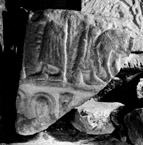
Object type: Part of coped monument [1]
Measurements: H. 55 cm (21.6 in); W. 48 cm (19 in); D. 31 < 40 > 23.5 cm (12.25 < 15.75 > 9.25 in)
Stone type: Fine-grained, pinkish-grey (7.5YR 6/2–7/2) feldspathic sandstone. Ashover Grit Member–, Marsden Formation, Millstone Grit Group, Carboniferous (R.T.)
Plate numbers in printed volume: Ills. 91–5
Corpus volume reference: Vol 13 p. 138-141
(There may be more views or larger images available for this item. Click on the thumbnail image to view.)
The carving on A and C seems to have been arranged in two registers of decoration divided by a plain flat moulding that traverses the stone horizontally on each side.
A (broad); Upper Register: By the break in the stone on the left are the remains of a vertical piece of carving that rests on the lower horizontal moulding and extends the full height of the register. To the right is a profile figure, facing left, wearing a full-length robe, whose head and shoulders have been lost in the upper break in the stone; the surviving portion of this figure is worn, but one arm appears to have been extended with a length of drapery hanging from it in a cascade of S-folds. The robe itself is marked by a series of parallel ribbed folds, a sense of three-dimensionality being provided by the way in which the far side of the robe is visible behind the feet emerging from the lower hem. To the right are the remains of another profile figure, facing right, who wears a similar full-length tubular robe, and whose feet are arranged to suggest a three-quarter turned pose: the left foot faces forwards, while the right is turned fully in profile. The head and shoulders of this figure have likewise been lost in the break in the stone and the area immediately below the break is very worn. However, between this figure and that on the left are a series of vertical, thin parallel mouldings that taper upwards to the right, suggesting this figure was winged. Furthermore, an arm appears to have been extended out to the right over the back of the profile equine creature that stands to the right. The hindquarters of this creature, which are well modelled, are carved on a plane in front of the winged figure, such that its tail passes over the robe and hangs down behind the foot. The remains of a saddlecloth or some other form of drapery hang over its back, extending slightly below the line of its belly; overlying it are the worn remains of the leg of the rider, the lower part of their torso visible above. It appears that the arm of the winged figure was extended out above the back of the beast towards the back of the rider.
Lower Register: Surviving in the lower register are the remains of three haloed figures facing forwards. That on the far left is largely lost in the break in the stone, but the side of the head and halo survive along with the upper edge of the left shoulder. To the right, and on a slightly lower level, are the head and halo of the second figure whose face, being worn but well modelled and carved in deep relief, is slightly elongated and may well have been bearded; a piece of carving over the line of the left shoulder also suggests the figure may have been long-haired. Set on a plane in front of both this figure and that which is lost in the break to the left is the diminutive head and halo of the third figure. The head is round and well modelled and the halo passes in front of the shoulders of both the larger figures behind it. To the right of second figure, and above the diagonal break in the stone, is an unidentifiable object: a vertical moulding with a triple-crested terminal inset with a central hollow.
B (narrow): Broken
C (broad); Upper Register: The upper register is filled with a central knot of four-strand interlace. Below, two strands emerge on each side to terminate in a pair of simple half-knots. On either side of this panel are the remains of foliate decoration; on the left this is badly damaged and worn but the remains of two spirals survive with a short stem extending from the upper spiral to terminate in a spear-shaped leaf tucked into the space between the spirals and the interlace knot in the centre. The foliate ornament on the right of the interlace comprises half a plant-scroll, part of the central stem of which survives by the break in the stone on the right. This bifurcates to form two spirals, the lower one of which is complete and contains a central cluster of four berries, the branch itself crossing the spiral to extend down to the lower half-knot of interlace and the horizontal moulding. A similar branch extends from the upper spiral and terminates in a spear-shaped leaf situated symmetrically opposite that on the left of the central interlace panel.
Lower Register: The area below the horizontal moulding traversing the stone is badly damaged, leaving no indication of any carved decoration that may once have existed.
D (narrow): Broken and dressed off
The disposition of the figures in the upper register of A suggests they represent the remains of two discrete narrative images: one involving the standing profile figure, facing left, with an arm outstretched before him; the other involving an angel, moving to the right, with his arm outstretched towards the rider in front of him. As far as the first of these is concerned, the original context within which the profile figure existed has been lost in the break in the stone, making it difficult to interpret either the figure’s identity, or the scene of which he was a part. The association of an angel with a rider, however, does allow for some explanations, as this combination of figures occurs only rarely in the extant corpus of early Christian art: the Journey to Bethlehem (Luke 2: 4–5); the Flight to Egypt (Matthew 2: 13–23); and the Entry to Jerusalem (Matthew 21: 8–11; Mark 11: 7–11; Luke 19: 36–44; John 12: 12–18).
Images of the Journey to Bethlehem generally consist of the Virgin and Joseph, with Joseph either leading or following the donkey on which Mary sits; sometimes, they are accompanied by Joseph’s son, who features in an apocryphal account of the episode in the Protoevangelium of James 17: 2 (James 1924, 45). In one instance, however, on one of the mid sixth-century ivory panels of the episcopal throne of Maximianus in Ravenna, Mary and Joseph are accompanied by an angel in a visual reference to the apocryphal account of the Gospel of Pseudo-Matthew 13 (James 1924, 74), in which an angel reveals to Mary the significance of a vision in which she sees lamenting and celebrating peoples. These are interpreted by the angel as the Jews (lamenting), and the Gentiles (celebrating). On the ivory plaque, however, the angel leads the donkey and turns back to look at Mary (Schiller 1971a, fig. 139). In no extant depiction of the Journey does an angel stand behind Mary on the donkey–as would have been the case if this iconographic version of the Journey was being depicted at Bakewell.
Joseph also features in depictions of the Flight to Egypt, where he leads the donkey on which the Virgin sits facing the spectator with the Child enthroned on her lap, as she does at Ruthwell, Dumfriesshire–although here there is no sign of Joseph (Ó Carragáin 2005, fig. 31; Hawkes 2015). When they are accompanied by another figure, it is again Joseph’s son, as in the fresco cycle at Müstair, Switzerland, dated to c. 800 (Schiller 1971a, fig. 316). Angels tend not to be included in such scenes, but the early fifth-century triumphal arch of Santa Maria Maggiore (Rome) does feature an angel standing alongside the Christ Child as he enters Sotina, near Heliopolis (Schiller 1971a, fig. 310)–as described in Pseudo-Matthew 23 (James 1924, 75)–but this scheme does not illustrate the Flight to Egypt, and neither the Child nor his mother is seated on a donkey. At Bakewell, the scheme clearly included a rider, although the damage to the stone means it is not possible to determine whether they were seated astride the mount, side-saddle or facing the spectator, nor whether a child was included. It is thus difficult to identify it within the general context of the iconography of the Flight to Egypt.
In the Infancy cycles surviving in early medieval art, however, both the Journey to Bethlehem and the Flight are preceded by illustrations of the Dreams of Joseph in which an angel appears by the bedside, often leaning over and stretching an arm out towards his sleeping body. On the Ravenna throne, Joseph’s First Dream, depicted in this manner, is set in a register above the Journey to Bethlehem, while at Santa Maria Maggiore his Second Dream is placed in the register above the Entry to Sotina. It is possible therefore that a model depicting either of these closely related episodes (of Dream and Journey, or Dream and Flight) was adapted to include the angel in the group at Bakewell. If this were the case it might be understood, as in most instances where angels accompany the Christ Child, as a signifier of his divinity in his human incarnation.
Images of Christ’s Entry to Jerusalem, on the other hand, feature Christ seated on a donkey, riding from left to right, and followed closely by either a group of figures or, in some instances, a single figure who leans in towards Christ on the donkey, his arm outstretched (e.g. fourth-century sarcophagus, Rome: Schiller 1972, fig. 31). Such images functioned from an early date as adventus scenes fore-shadowing the Second Coming; the triumphal entry of Christ into Jerusalem anticipated his triumphal entry into the Heavenly City (Deshman 1995, 77–89). However, none of the surviving versions of the Entry includes an angel, making it difficult to identify this group of figures as depicting this episode.
Consideration of the theological relationship of the Entry with the Flight may, nevertheless, be relevant here, for the Flight was understood to anticipate the Entry: in both episodes Christ, enthroned in triumph on a donkey, enters a city where (according to the Pseudo-Matthew account) idols fall in recognition of his divinity (Schiller 1971a, 117–18), while in Jerusalem Christ’s entry precedes his cleansing of the Temple. Given this, it is possible that the iconography of the Flight was adapted to depict or refer, symbolically, to the Entry. However, the rarity of the angel accompanying the Holy Family in images of the Flight means this cannot be substantiated with any certainty.
With the loss of the details of the rider at Bakewell, it thus remains difficult to identify the scheme involving a figure on horseback accompanied by an angel. While the iconography of the Journey, the Flight and the Entry can explain a rider accompanied by an angel, none provides an exact parallel for the configuration on Bakewell 34. Whatever scheme the carving was intended to depict, the established iconography would have to have been adapted to include the angel and situate him behind the rider.
This uncertainty also means the original context of the fragmentary figure to the left is unrecoverable. If the scene involving the rider could be identified as the Journey, it might be possible to suggest that the previous scene presented the Dream of Joseph, but this would involve identifying the standing figure as an angel–an unlikely hypothesis as the figure is not winged. If the rider scene could be identified as the Flight, it might be tempting to explain the preceding scene as the Presentation in the Temple (in which case the standing figure might be seen as Simeon receiving the Child), or the Adoration of the Magi (in which case the standing figure might be identified as one of the Magi). If, on the other hand, the rider scene was to be identified as the Entry, this standing figure could be explained as part of the Raising of Lazarus, the episode immediately preceding the Entry in the gospel accounts.
However, it is highly unlikely that any of these episodes was originally depicted at Bakewell, as each suggestion rests on the supposition that the scenes were selected to display a chronological unfolding of biblical events: Anglo-Saxon art, particularly the sculpture, tends not to illustrate events in this manner, having other iconographic functions (Hawkes 2003c). Thus, even if it were possible to identify the scene involving the angel and rider with greater certainty, it is unlikely that this would allow a credible postulation of the identity of the scene on the left.
Identifying the remains of the lowermost register is an equally uncertain prospect. The three haloed figures bear no attributes that help to identify them; the identity of the object on the right is unclear. Furthermore, three such standing figures form too generalised a group to allow them to be considered in the light of episodes or groups of figures surviving in Christian art more widely. Nevertheless, it is tempting to interpret them as part of an extended scheme illustrating a series of standing figures separated by vertical mouldings, as is the case with the Hedda Stone at Peterborough (Bailey 1990, 8–11, fig. 4: see Ill. 647); this would allow for one explanation of the group of three figures in the lower register of Bakewell 34 (as part of a series of apostolic figures) and of the feature surviving to their right. It would also enable the reconstruction of a substantial coped monument or shrine featuring a scheme of standing figures along one side, with a series of events above, one of which (if it depicted the Flight or Entry), would have had references to the adventus of the Second Coming.
The incomplete nature of the carving does mean that such explanations must, of necessity, remain extremely hypothetical. But the interlace and plant-scroll on C do indicate that whether the monument was originally placed inside or outside a building such as a church, it was designed as free-standing and intended to be viewed in the round. If it was designed as a shrine, or cenotaph, this has implications for our understanding of access to such objects of veneration in the Anglo-Saxon Church. The Hedda Stone is decorated with the standing figures of Christ, the Virgin and apostles on both long sides, with interlace and plant motifs set in panels on the gabled/coped upper portion of the monument. Here, dowel holes interspersed along the horizontal length of each side have been reconstructed as fittings for a rail, allowing the figures to be hidden by a curtain and ritually revealed. Furthermore, research into such shrines in early medieval ecclesiastical contexts indicates that such cenotaphs were likely raised above ground-level–set over a structure that raised them to eye-level (Nilson 1998; Crook 2000). An early analogous arrangement is recorded at Holy Island, where Cuthbert’s coffin, following the translation of the saint, was set on top of the sarcophagus that had originally held his remains (Bede, HE IV.30: Colgrave and Mynors 1969, 444–5; V.Cuth. 43: Colgrave 1940, 296–7). The fragmentary nature of Bakewell 34 means such reconstructions are impossible here, but the analogies do provide some indication of the potentially impressive nature of the monument and its function within an ecclesiastical setting.
Overall, the remains of the group of three figures in the lower register of A, are too fragmentary to provide any indication of the iconographic type lying behind them, which might suggest the date of the potential source lying behind the scheme. Yet, as a series of standing figures they are probably best situated in within a late eighth-/early ninth-century context, while the use of interlace which merges into plant-scroll, on the reverse of the coped stone, is best paralleled in a sculptural context outside Bakewell (although it also occurs on Bakewell 8), on Sandbach Market Square 1, which is dated to the early ninth century (Hawkes 2002a, 85?93; Bailey 2010, 112).
