Select a site alphabetically from the choices shown in the box below. Alternatively, browse sculptural examples using the Forward/Back buttons.
Chapters for this volume, along with copies of original in-text images, are available here.


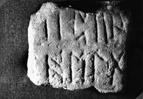
Object type: Inscribed fragment [1]
Measurements: H. 23 cm (9 in); W. 30 cm (12 in); D. 11 cm (4.5 in)
Stone type: Greyish orange (10YR 7/4) poorly sorted clast-supported feldspathic sandstone. The subangular to subrounded clasts range from 0.3 to 0.6 mm, but mostly are about 0.5 mm. Ashover Grit Member?, Marsden Formation, Millstone Grit Group, Carboniferous (C.R.B.).
Plate numbers in printed volume: Ills. 96–7
Corpus volume reference: Vol 13 p. 142-143
(There may be more views or larger images available for this item. Click on the thumbnail image to view.)
Inscription The fragment bears two lines of fairly deeply incised Anglo-Saxon runes. The tops of the first line are broken away with the edge of the stone, leaving some readings uncertain, but it is most likely that there were four characters here, as there clearly are on the second line. There was probably further text both above and below the surviving fragment, and the lines may have continued to the right. The spacing at the left, however, suggests that the beginnings of the lines are likely to be intact. The complete runes in the second line are about 10 cm high.
The inscription reads:
. p . o
h e l g
The text begins with two vertical staves broken away at the top. There is less damage to the second, which clearly had no branch to its right and is evidently, therefore, either ‘i’ or the second upright in a more complex rune joined at the top. The spacing tends to favour the latter option, in which case the reading will have been ‘e’, since other characters, including ‘m’, would have been expected to leave traces in the visible surface. If the spacing is misleading, and the first stave represents a separate rune, the most reasonable possible readings for the sequence would be ‘li’ or ‘wi’. The relatively wide undamaged space before the next rune may suggest a word-break. The following ‘p’ is very clear, its top broken away only very slightly. There follow two more staves, the second of which curves back slightly towards the top of the first. It looks most like ‘u’, though since the top is missing it is just possible to imagine an unusually elongated ‘r’. The possibility needs consideration since–as discussed below–the context favours ‘r’ over ‘u’. The final rune on the first row is also damaged, but a stave with a lower arm and tick survives: this appears consistent only with the distinctively Anglo-Saxon form of ‘o’. The readings in the second line are clear: a conventional double-barred ‘h’ is followed by a rather unsymmetrically formed ‘e’, then ‘l’, and a ‘g’ which is also rather unsymmetrical and has lost a fraction of its lower right-hand side at the break of the stone.
Inscription Although the text is fragmentary, it is possible to make two suggestions of some substance about the inscription and its significance. First, the sequence ‘helg’ is most readily interpreted as part of a widely attested Scandinavian personal name, masculine Helgi or feminine Helga (for examples of which from England see Insley with Rollason 2007, 225, with further references). This would tend to imply a date in the second half of the ninth century or later, and place the inscription in a cultural context of Anglo-Scandinavian contact. Second, a sequence ‘p*o’ on an inscribed stone from Anglo-Saxon England inevitably suggests the recurrent Latin memorial formula ora(te) pro, ‘pray for’ (compare, e.g., Okasha 1971, nos. 9, 10, 42, 46, 47, 67, 68, 111, 150, 152; for vernacular equivalents see brief discussions in Coatsworth 2008, 81 and Bailey 2010, 93-4). This in turn would indicate a memorial text, in line with the great majority of Anglo-Saxon runic inscriptions in stone.
Neither conclusion can of course be accepted as quite certain given the lack of clear context. An inventive philologist might be able to justify a division between h and elg, or might argue that helg here represents an unattested form of the Old English adjective hālig, ‘holy’ (to which, indeed, the Scandinavian personal name is related).[2] A sceptic could certainly look at the fragmentary letter between ‘p’ and ‘o’ and argue that it suggests ‘u’ rather more than ‘r’. Moreover, there are no instances of ora(te) pro in Anglo-Saxon runes, and so this would involve an unparalleled combination of script and formula. Nonetheless, with all due caution, it remains tempting to suggest that the Bakewell fragment might be read ‘[orat]e pro Helg’. Personal names are the single most common element in inscriptions of the period, and Helgi and Helga are familiar as personal names, albeit of Scandinavian origin. If there are problems with the reading ‘pro’, a sequence ‘puo’ would be much more challenging and certainly cannot be paralleled from the Anglo-Saxon epigraphic corpus. Interplay between Latin and the vernacular, and Roman and runic scripts, is characteristic of the Anglo-Saxon epigraphic tradition (Page 1989; Fell 1994). A clear parallel for the use of English runes on a memorial in an Anglo-Scandinavian context comes from Crowle in Lincolnshire (Everson and Stocker 1999, 147-52), and a lost fragment from Leeds may have a Scandinavian personal name, as here (Coatsworth 2008, 207). See also the discussion of the arrangement of the Leek runes (Leek 1, p. 296).
One point that remains to be made about the Bakewell and Leek inscriptions is that on a distribution map of Anglo-Saxon rune-stones they mark the southern limit of a tradition that can essentially be characterised as Northumbrian: see the map in Parsons 1999, 111, and–if Bakewell can be related specifically to memorial texts in runes–the map and discussion in Coatsworth 2008, 78-84.
