Select a site alphabetically from the choices shown in the box below. Alternatively, browse sculptural examples using the Forward/Back buttons.
Chapters for this volume, along with copies of original in-text images, are available here.


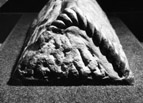
Object type: Coped monument [1]
Measurements: L. 104 cm (41 in); H. 25.5 cm (10 in); W. max. 39 cm (15.4 in)
Stone type: This stone has a highly patinated surface which makes identification difficult. Greyish orange pink (5YR 7/2), moderately sorted, clast-supported quartz sandstone. The sub-angular to sub-rounded clasts range from 0.3 to 0.5 mm. Millstone Grit Group, Carboniferous (C.R.B.)
Plate numbers in printed volume: Ills. 87–90
Corpus volume reference: Vol 13 p. 136-138
(There may be more views or larger images available for this item. Click on the thumbnail image to view.)
The monument is ridged and appears slightly ‘bowed’, although the ridge is damaged. Cable mouldings articulate the edges of the stone on the right and left, with a similar moulding along the ridge, much of which is damaged. The base is edged by a long plain moulding.
A (long): Decorated with four panels containing zoomorphs of indistinct form with a central panel of interlace or plait-work. The panel on the extreme left is filled with a beast flanked on each side by a now indistinct feature. The top of the panel is particularly worn but the head appears to turn to the right with the ears, an eye and a mouth being visible. To the right is a strand of interlace which curves down to the left between the animal’s legs; these appear to terminate in three closed circles. The panel is contained by the edge cable moulding on the left and a broad, plain, vertical moulding on the right.
Moving to the right, the second panel contains another zoomorph, a leaping dog-like back-turned creature. The front legs are barely visible but the hind flank can be discerned on the left. The animal has a long neck and large head filling the top-left of the panel. An eye, ear and open mouth can be seen. Interlace fills the panel around the zoomorph. At the top right this is indistinct but below it appears as a wide looped design. Another strand (or possibly the same) appears to envelope the hind quarters of the animal and extends to a series of four (possibly closed) loops at the bottom of the panel.
To the right is a band of close interlace or ‘basket’ plaitwork, the strands of which are worn smooth but it appears to have been composed of four strands terminating at the bottom in return curved loops. The top of the interlace is indistinct as is the ridge above, with a crack extending across the panel and on to C. No mouldings frame the interlace.
To the right is a panel containing what appears to be a rampant zoomorph, the head hanging and turning to the right, the body perhaps facing left. There appears to be a central dividing strand that terminates at the top as a tight, closed, loop, but this is indistinct. What forms part of the animal, as distinct from interlace in this panel, is unclear, especially at the bottom where one or two feet seem to be visible and possibly a paw grasping at the hind quarters. To the right is a broad, plain, vertical moulding which is damaged.
The panel at the extreme right is filled with another zoomorph that, given the extensive wear, is indistinct. The creature appears to face left with its head hanging down. A carved element crosses the animal’s body which may be a rider’s leg but there is insufficient space to accommodate a rider, suggesting the element is more likely to be a strand of interlace. Below the animal there appears to be an interlace design but it is too indistinct to ascertain its details.
B (end): This triangular panel appears to be filled with two zoomorphs flanking a central, thick, stem which can probably be identified as a stylised tree whose branches extend outwards near the top. The animal on the left is turned to the right with its head back-turned to the left; the hint of an eye and a beak-like jaw are visible. Its back is curved and there may be interlace below but this is unclear. The animal on the right may have adopted a similar stance although the lack of detail renders this uncertain; the legs of this creature are more discernible than those on the left.
C (long): Decorated with a series of three panels of interlace. That on the left is dominated by a moulded saltire cross surrounded on either side, above and below by trefoil designs of simple, looped interlace, which are of different sizes and shapes filling the spaces available. To the right is a plain vertical moulding. Strands of interlace extend from the upper and lower right-hand arms of the cross into the adjacent panel on the right.
The central panel contains a narrow interlace pattern composed of two simple looped designs at the top and bottom, which are connected by a single strand to the panels on either side. In the centre is a four-leaf design extending from a stem linking it to the looped motif above and below, although the stone is broken here and detail is unclear.
The panel on the right is filled by another saltire cross extending across the entire field. The ends of the cross-arms loop back on themselves and run into the left and right armpits to form V-shaped strands parallel to the arms. A large, closed, loop of interlace runs around the cross passing under and over the arms, near their extremities, and through the returned strands.
D (end): This end panel is decorated with what appears to be an interlace design, although it is badly damaged and worn and the detail is difficult to decipher. It may have contained some form of zoomorph; the hint of an animal form is preserved on the left but this is too indistinct to be certain.
This is a coped monument which may have formed the cover of a box sarcophagus or was intended to lay over an interment below ground. The wear pattern on the top suggests that it may have been touched repeatedly, although it is not clear whether this transpired before it was reused, presumably in the Norman period, or after it was put on display in Bateman’s collection (see Bakewell 2, p. 113). Coped monuments are rare in this region but this is one of two from Bakewell (see also no. 34) suggesting that this location was a significant place of burial throughout the Anglo-Saxon period, along with other sites of high ecclesiastical status in the area: at Repton, Derby and Wirksworth.
One of the problems with any analysis of worn pieces such as this is the interpretation of the carved decoration, where damage and wear results in confusion and misinterpretation. The earliest known drawing of this monument is that by Bateman in 1855, who illustrates the panels on each face (Bateman 1855, 187). On A, he depicts the panel on the extreme left as filled by a rampant beast with interlace; that next to it as containing a passant beast with interlace; and the panel second from the right filled with a rather odd-looking animal resembling a serpentine elephant, suggesting that either this was a mythical beast or, more likely, that Bateman was unsure of the form of the zoomorph. On the extreme right Bateman depicted a horse and rider, although this is clearly a distortion of the visible remains. On C he reproduced the interlace designs, although the drawing of the panel on the right is again a distortion of the surviving decoration. Two rather startled-looking beasts are shown on B, along with a stylised tree, but the decoration of D seems to have defied Bateman’s abilities of interpretation. Browne (1886, 174) also described the carving, considering the decoration on A to be ‘uncouth’ animals, but it is clear from his account that even in the nineteenth century, it was difficult to decipher the reliefs. He refers to one zoomorph as a possible elephant or mammoth (most probably influenced by Bateman’s drawing), and his own rubbing that accompanied his account shows a human figure in the panel second from the right on A, probably an angel, with obscure detail to its right. In the extreme right-hand panel, Bateman’s ‘horse and rider’ have become a serpentine zoomorph, suggesting that, like Bateman, a degree of licence had been applied to create the drawing. Routh’s account of 1937 describes the zoomorphs on B as a pair of deer flanking a tree, while on A, he interprets the carvings in the two panels on the left as depicting ‘Anglian beasts far gone in conventionalism’, and an elephant and a horse in the other two panels which are ‘very badly drawn’ (Routh 1937a, 16; 1937b, 18). Clearly, Routh was not impressed by this monument, describing it as ‘the most debased of all’ with ‘meaningless’ interlace and belonging to ‘the last decadent phase of the Anglian period’ (Routh 1937a, 16-17; 1937b, 18), sentiments that were likely based on Collingwood’s understanding of a sculptural chronology reflecting a rise and fall of ‘national’ morality (Collingwood 1927, 20-1).
It is clear that Bateman, Browne and Routh interpreted the iconography differently, suggesting that, ever since the stone was discovered in the early- to mid-nineteenth century it has been as difficult to decipher the decoration as it is now. All that can be said with certainty is that one side of the monument (A) is zoomorphic, and the other (C) filled with interlace. The zoomorphic scheme may have represented a possible hunting scene, with or without the hunter, a theme commonly expressed in pre-Norman, Scandinavian period sculpture, although in such contexts the hunter is usually included. The bowed profile of the monument is suggestive of a ‘hogback’, but its design does not follow the expected form or decoration of the more familiar hogbacks found elsewhere in Cumbria and northern Yorkshire (Bailey and Cramp 1988, 29-30; Lang 2001, 21-4). Nevertheless its decoration does have more in common with the Anglo-Scandinavian hogbacks than the other coped monument at Bakewell (34) in that the latter is more overtly Christian in its frame of reference, whereas this piece seems to present the more secular (and not overtly Christian) iconography found on many of the Viking-age sculptures (see, e.g. Aspatria 6, Cumbria: Bailey and Cramp 1988, 53–4).
