Select a site alphabetically from the choices shown in the box below. Alternatively, browse sculptural examples using the Forward/Back buttons.
Chapters for this volume, along with copies of original in-text images, are available here.


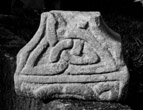
Object type: Cross-arm and part of shaft [1]
Measurements: H. 27 cm (10.6 in); W. 35 cm (13.8 in); D. 17 cm (6.7 in)
Stone type: Fine-grained, greyish orange pink (5YR 7/3) feldspathic sandstone. Millstone Grit Group, Carboniferous (R.T.)
Plate numbers in printed volume: Ills. 83–6
Corpus volume reference: Vol 13 p. 136
(There may be more views or larger images available for this item. Click on the thumbnail image to view.)
A (broad): This face is decorated with the terminal of what appears to be a three-strand interlace. The terminal draws the strands of the interlace together in two V-bends with an internal loop. The edge of the cross-arm is demarcated by a thin edge moulding which also forms the top of the frame of the panel of decoration on the shaft, below. The decoration on the shaft element is too fragmentary to decipher, but it may have been an interlace pattern. The rest of the cross-arm decoration has been truncated.
B and D (narrow): Undecorated
C (broad): This face is decorated with a similar interlace pattern as on A, although slightly less of it survives. Traces of mortar suggest that it may have been used as building material, or was once cemented into a display. As with A, the cross-arm is contained within a thin edge moulding which also forms the top of the frame of the panel of decoration on the shaft below, which curves to compliment the cross-arm terminal. The decoration on the shaft element is too fragmentary to decipher.
F (bottom): Most of the shaft has been broken away.
This appears to be the remains of the lower cross-arm with a very small part of the shaft remaining. The head appears to have been of type C10 although the arm is too fragmentary to be certain (Cramp 1991, xiv). Although so little remains, the decoration appears to follow the general pattern of cross-arms elsewhere in the region, where the main decoration along the arms includes an interlace pattern–as on Rowsley 1 (Ills. 408-9).
