Select a site alphabetically from the choices shown in the box below. Alternatively, browse sculptural examples using the Forward/Back buttons.
Chapters for this volume, along with copies of original in-text images, are available here.


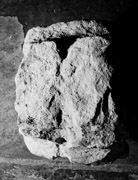
Object type: Part of lateral cross-arm [1]
Measurements:
A: H. 32 cm (12.5 in); W. 29 cm (11.4 in)
B: H. 22 cm (8.6 in); W. 22 cm (8.6 in)
C: H. 31 cm (12.2 in); W. 27 cm (10.6 in)
D: H. 23 cm (9 in); W. 22 cm (8.6 in)
E: H. 16 cm (6.25 in); W. 21 cm (8.25 in)
F: H. 25 cm (9.8 in); W. 23 cm (9 in)
Stone type: Calcareous, moderately sorted, medium-grained sandstone. Clasts range from 0.3 to 3 mm, but most are in the range 0.3 to 0.5 mm. The bigger clasts appear to be rounded shell fragments. Ipstones Edge Sandstone?, Millstone Grit, Carboniferous (C.R.B.)
Plate numbers in printed volume: Ills. 76–82
Corpus volume reference: Vol 13 p. 135-136
(There may be more views or larger images available for this item. Click on the thumbnail image to view.)
The fragment represents the square terminal of a lateral cross-arm whose armpit curve is clearly visible on A and C. Plain narrow roll mouldings survive bounding the decoration of the main faces.
A (broad): The face is filled by the well-formed spiral of a plant-scroll that terminates at the centre with a cluster of three berries. A thin stem emerges from the second turn of the spiral where the node is marked by three circular bands; it crosses the outer turn of the spiral towards what would have been the centre of the cross-head and terminates, at the break in the stone, in the worn remains of a bud or leaf.
B (end of cross-arm): Originally the end of the cross-arm, the carving is damaged and worn, but the remains of a figure can still be discerned. The top of the head is lost in the break along the top edge, but it was oval-shaped and well modelled. The lines of the shoulders are clearly visible, indicating that the figure wore a plain under-garment with a pleated over-garment that crosses the torso from the right shoulder in a series of heavy ribbed folds. The right hand crosses this drapery at chest height, emerging from a long sleeve with a double band marking the hemline; all four fingers rest on a prominent square object held in front of the left shoulder by the left hand which grasps it from below.
C (broad): Most of this face is covered with mortar, but a long thin moulding remains, traversing the arm to the right-hand edge from the upper break where it would have passed into the upper cross-arm; a slightly wider, flatter piece of carving survives on the left. Small bulbous pieces of mortar adhere to the surface making it unclear whether the carving represents the remains of foliate ornament.
D: Broken; this represents the juncture of the cross-arm with the centre of the cross-head
E: Originally the top of the cross-arm, the face is composed of a plain, roughly dressed panel contained within the plain mouldings framing it.
F: Originally the underside of the cross-arm, the decoration comprises the remains of a panel of well-formed interlace carved in deep relief.
The presence of a human figure preserved on B, the end of the cross-arm (the opposing face, D, representing the point of junction between the cross-arm and the cross-head), indicates that this piece formed one of the lateral arms of a cross-head, and, although the dimensions of this face (22 cm / 8.75 in) are narrower than the depth (32 cm / 12.6 in) of the remains of the lower cross-arm surviving at the top of Bakewell 1 (on B and D), this face of the stone is incomplete, lacking the roll mouldings that would once have framed it. In its complete state, therefore, the dimensions of this piece are not inconsistent with the dimensions of the cross-head that can be assumed to have surmounted Bakewell 1; if this is indeed the case, Bakewell 31 may have formed the lateral cross-arm of Bakewell 1D. Clearly, such a supposition must remain conjectural, not least because the stone types vary slightly although both are of a moderately sorted, medium-grained sandstone. More problematic is the fact that there is no evidence that the cross-head fragment was recovered from Bakewell itself, or brought to the Museum from elsewhere. Nevertheless, as already outlined (see Bakewell 1), the type of plant-scroll on A, the type of interlace on E, and the style of the figure on B, all link the piece with the centre of production responsible for Bakewell 1. Furthermore, while it is uncommon to find motifs carved under a cross-arm, this does occur elsewhere in the region–on Eyam 1, for example (Ill. 208).
The figure itself is particularly distinctive in this context, in that it holds a book in the left hand and gestures to it, prominently, by placing the right hand over it. Of the figures preserved on the remains of the cross-heads of Bakewell 1, Eyam 1 and Bradbourne 4–5, only that on Eyam 1D possibly holds a book (Ill. 209), but the worn condition of this figure means this is far from certain. Yet, like that figure, and the one preserved in the cross-arm of Bakewell 1B (Ill. 14), this (on 31B) does not appear to have had wings. The right shoulder stands in high relief with no sign of the characteristic ribbed mouldings that distinguish the wings of the angels featured on Eyam 1 and Bradbourne 4. The lack of wings and the presence of the book displayed so prominently by the Bakewell figure, thus indicate that he might be identified as one of the apostles, or more specifically, one of the evangelists. However, if Bakewell 31 was originally part of Bakewell 1, it is more likely that this figure should be identified in the light of that staff-bearing figure, and so should perhaps be regarded as another clerical figure, functioning as a further reference to the ecclesiastical nature of the monument.
