Select a site alphabetically from the choices shown in the box below. Alternatively, browse sculptural examples using the Forward/Back buttons.
Chapters for this volume, along with copies of original in-text images, are available here.


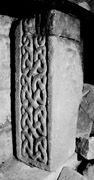
Object type: Part of shaft [1]
Measurements: H. 84 cm (33 in); W. 30 > 28 cm (11.8 > 11 in); D. 26.5 > 26 cm (10.4 > 10.2 in)
Stone type: Fine-grained, pinkish-grey (7.5YR 6/2–7/2) feldspathic sandstone. Millstone Grit Group, Carboniferous (R.T.)
Plate numbers in printed volume: Ills. 72–4
Corpus volume reference: Vol 13 p. 133-134
(There may be more views or larger images available for this item. Click on the thumbnail image to view.)
A (broad): About three-quarters of this face is dressed away, but a small part of a four-strand interlace survives towards the top; it appears less than symmetrical. Edge mouldings seem to be preserved on each side.
B (narrow): Decorated with a simple spiral scroll with only one (centre) now complete, the others truncated. The scrolls appear to terminate in the centre with a strand which disappears below the outer strands to connect to the spiral below. The edge mouldings are badly damaged and the lower part of the face has been broken away.
C (broad): Obscured by its location next to the church wall, but appears to have been dressed-off.
D (narrow): Decorated by a simple interlace design comprising a series of turned, Stafford Knot style patterns with V-bend terminals. Each side of the pattern is linked to the other by cross-over strands. The pattern is reasonably well-executed and appears to be complete at the bottom where there is a horizontal frame; detail below is now lost and the pattern is truncated at the top. There are edge mouldings on both sides, although they appear to have been subsequently dressed.
Part of a rectangular-sectioned cross-shaft, the fragmentary nature of this piece makes it difficult to discuss in detail. The four-strand interlace on A is ubiquitous to Anglo-Saxon sculpture, while the interlace pattern on D is found elsewhere in the region: on Blackwell 1 (East Derbyshire), Alstonefield 2, or Leek 1 in Staffordshire (Sidebottom 1994, 103). The spiral scroll on B is a particular feature of Bakewell sculpture, albeit in a variety of forms, and is also found elsewhere: on Two Dales 1 and Brailsford 1 in Derbyshire or on Ilam 2, Alstonefield 9 and Chesterton 1 in Staffordshire. Together these shared features suggest a date in the tenth century is most likely.
