Select a site alphabetically from the choices shown in the box below. Alternatively, browse sculptural examples using the Forward/Back buttons.
Chapters for this volume, along with copies of original in-text images, are available here.


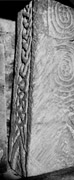
Object type: Part of shaft [1]
Measurements: H. 86 cm (33.8 in); W. 42 > 35 cm (16.5 > 13.8 in); D. 23 > 22 cm (9 > 8.7 in)
Stone type: Fine-grained, pale orange (10YR 8/2) feldspathic sandstone. Millstone Grit Group, Carboniferous (R.T.)
Plate numbers in printed volume: Ills. 65–7
Corpus volume reference: Vol 13 p. 132-133
(There may be more views or larger images available for this item. Click on the thumbnail image to view.)
A (broad): This face is filled with two incomplete scroll or spiral patterns. That at the top is composed of a single strand which forms four spirals terminating in a cluster of six berries at the centre; the spirals lack symmetry. The outer strand terminates in what appears to be a node on the left-hand side, although this part of the stone is damaged. The lower spiral scroll appears to connect to the node by its outer strand, although, again, this area is damaged. It is similar to that above and again terminates in the centre as a cluster of six berries. The left-hand side is badly damaged with part missing and below most of the pattern is missing through dressing-off. However, there appears to have been a multi-strand interlace which may have been connected to the spiral scroll above. There appears to be a small cluster of three berries between the scroll and interlace on the right-hand side. One strand of the interlace extends downwards on the right-hand side, linking with a second strand as a tapering twist pattern which terminates at a point at the bottom where further detail is lost. On each side of the decoration are edge mouldings which appear to be flat-banded, although this may be due to subsequent dressing. That on the left is only visible at the very top.
B (narrow): Much of this face has been badly damaged and broken away. What remains of the decoration, in the centre of the face, is a key pattern comprising vertical and horizontal elements. On each side are edge mouldings, as on A.
C (broad): Inaccessible, being pushed up against a wall in the church. It seems to have been so badly damaged that it is unlikely that much decoration survives, but there is a trace of an interlace detectable.
D (narrow): Decorated with a three-strand simple interlace which is truncated at the top. At the bottom the strands terminate in sharp v-bends. Below is an inverted ‘V’ which may have been a frame or arcade for detail below; however, the stone is truncated here, so this is uncertain.
Part of a rectangular-sectioned cross-shaft, the decoration is reasonably executed although it lacks symmetry, especially in the spiral scrolls of A. The use of the spiral scroll is a particular feature of free-standing sculpture at Bakewell, being found on several sculptures here (e.g. Bakewell 2 and 4) and is probably a motif developed from the Northumbrian style of plant-scroll used for the larger surviving monuments at Bakewell 1, Eyam 1 and Bradbourne 1. The execution of the design suggests that the craftsperson may, however, have been less skilled. The key pattern on B, derived ultimately from classical art, is found on several pieces in the region and on both round and rectangular-sectioned shafts, and is often accompanied by simple interlace patterns (see, for example, Stoke-on-Trent 1 or Ilam 2D).
