Select a site alphabetically from the choices shown in the box below. Alternatively, browse sculptural examples using the Forward/Back buttons.
Chapters for this volume, along with copies of original in-text images, are available here.


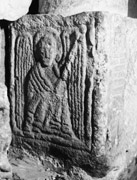
Object type: Part of cross-base? [1]
Measurements: H. 49.5 cm (19.5 in); W. 42 cm (16.5 in); D. 36 cm (14.1 in)
Stone type: Coarse-grained, very pale orange (10YR 8/4) feldspathic sandstone. Kinderscout Grit or Ashover Grit, Millstone Grit Group, Carboniferous (R.T.)
Plate numbers in printed volume: Ills. 61–3
Corpus volume reference: Vol 13 p. 130-132
(There may be more views or larger images available for this item. Click on the thumbnail image to view.)
The carving is framed by thin inner roll mouldings bounded by well-formed large round angle mouldings set vertically along the edges of the block.
A (broad): The carving on the right is lost in damage to the stone, and that to the left is badly worn. Originally centrally placed, are the remains of a haloed, veiled forward-facing figure. The face was well modelled and oval-shaped, with a fold of drapery continuing round the left of the face, over the shoulder and across the chest; the outlines of an eye, the nose and chin are still visible under the damage. The outline of the left-hand side of the torso indicates that the arm was bent across the body. The clothing was formed by a series of regular neat parallel ribbed folds crossing the body diagonally from the shoulder. The area to the left of the figure is filled with a series of horizontal parallel plain flat mouldings above which are two short horizontal rectangles from which emerge two curved oval terminals. Below the horizontal mouldings is a vertical feature, lightly incised with vertical parallel lines, which curves to the left. In the space between this and the inner roll moulding is an indistinguishable feature with a bulbous shape under the curve set over an irregular vertical feature.
B (narrow): A nimbed, three-quarter length angel fills the panel; the upper part of the head and nimbus are damaged in the upper break in the stone, but the head was well modelled and oval-shaped. The figure wears a plain undergarment with a heavily pleated over-garment arranged in parallel folds over the right shoulder and hanging the over the arms to form a series of S-shaped folds that cascade over the lower part of the body. Both arms cross the body to grasp a long rod held diagonally over the left shoulder, the top being lost in the upper break of the stone; the lower end terminates just above the lower frame of the panel. The wings, defined by a series of narrow parallel vertical mouldings that taper at the tips, flank the figure on each side.
C (broad): Inaccessible; unknown
D (narrow): A nimbed, three-quarter length angel fills the panel. He has a well-modelled, oval-shaped face, with short hair, and wears a plain undergarment with a heavily pleated over-garment arranged in parallel folds over the right shoulder and the arms to form a series of S-folds that cascade over the lower part of the body in a manner comparable to that of the garments worn by the angel on B. And, as with that figure, the arms of this angel cross the body to grasp a long rod held diagonally over the body so that the lower end terminates just above the lower frame, and the upper end, which extends up to the upper right-hand corner of the panel, terminates in a trefoil motif formed by three distinct circular features. There is some damage to the carving at the point where the hands emerge from the drapery, but it appears that this angel, like that on B, held the rod with both hands. The wings sweep upwards on either side of the head, and like those on B, extend down either side of the body as a series of narrow parallel vertical mouldings that taper at the tips.
Beyond noting the existence of this piece, there have been few discussions of it other than passing comments concerning the fine quality of the carving and the probability that the figures preserved on it provided the inspiration for the figural style used on Bakewell 1 (and 31), Bradbourne 1 (and 4–5) and Eyam 1 (Routh 1937, 26; Plunkett 1984, 122). Certainly the high relief tubular ribbed folds of the robes worn by the angels on B and D, along with the sweeping S-folds of the garments draped over their arms, the coherent attitude of the hands grasping the tri-lobed staff/s over their shoulders, and the manner in which the wings are formed–with long vertical ribs marking the feathers, and the distinctive upper rib forming the outline–are all features characteristic of the angels and associated figures preserved on the cross-shafts and cross-heads at Bakewell, Bradbourne and Eyam. The manner in which the feet of figures, such as the Virgin at Eyam, protrude from under the folds of her garments may also indicate, as suggested by Plunkett, that the three-quarter length figures reproduced on Bakewell 26 may have been adapted in a less coherent manner elsewhere. They would have to have been further adapted, however, to depict them without haloes, as only the figures on Bakewell 26 are depicted with large flat circular haloes.
Despite such discussions, there has been little attempt to determine the iconographic function of the surviving group of figures; this is no doubt largely due to the badly damaged condition of the figure on A. Nevertheless, this can be identified as female given the manner in which the uppermost folds of her garment surround her head and fall over her shoulders to meet under her neck in the manner of a veil. Her face is also distinguishable as having had a rounded jaw-line, a well-modelled mouth and nose with well-formed eyebrows and deeply set eyes: the whole being surrounded by the impressively large halo. The setting has also proved problematic. As noted by Plunkett (1984, 122), this may have formed either a chair-back or a brick wall. Within the context of such an elaborate depiction of a female figure–who can most likely be identified as the Virgin Mary (see Hawkes 1997a)–both these suggestions are possible. Painted panels featuring the Virgin in art of the sixth to ninth centuries in the Eastern Mediterranean world and Rome show her seated on a large throne with a wide back, projecting arm-rests and an elaborate cushion. Other such paintings of the period portray Christ and Saints enthroned in similar fashion, but some also show them standing before an architectural feature intended to depict the curving wall of an apse. In both cases the curved wall and the throne feature elaborate terminals, that in some cases are rounded, and can be set at head height (for examples, see Nelson and Collins 2006). Within these contexts the curved feature in the lower quadrant of the Bakewell panel is best explained as the (possibly misunderstood) representation of the elaborate arm-rest of a throne or, less likely, the (misplaced) remains of the bolster cushion.
This explanation of the figure, as derived from an icon-type depiction of the Virgin enthroned of eastern Mediterranean origin, is further supported by the presence of the two staff-bearing angels flanking her on B and D. Such figures are included in almost all images of the Virgin, with or without the Christ Child on her lap. Whether the Child was present here cannot be determined as the damage spreads across the area where he would have been situated. Nevertheless, the scheme, as it survives, indicates iconographic references to the elevated status of the Virgin in her role as Theotokos (Mother of God), which was current in Anglo-Saxon England by the eighth century (Clayton 1990), and which seems to have been reproduced at Eyam. The relatively coherent rendition of the figures on Bakewell 26, the ‘classical’ nature of the facial features of the Virgin, and the associated details all point to dependence on a model depicting the Virgin flanked by angels that was not far removed from an eastern icon-type of early (perhaps sixth-century) date. The likelihood that the related figures at Bakewell, Bradbourne and Eyam may also reflect such influences, but are carved in a manner involving deeper relief and greater stylisation, suggests that this piece may be dated early in the sequence, but not too far removed from them; equally it may suggest that the stone was lightly carved—and painted—in order to deliberately recall two-dimensional painted panels.
The other aspect of the stone that has received little scholarly attention is its original function. Given its comparative inaccessibility–with only three of its four sides now visible, and the upper surface completely invisible–this lack of discussion is understandable, while the unique form and dimensions of the piece in the extant corpus of Anglo-Saxon sculpture (or the wider early medieval world) further limit attempts to identify it. The size of the stone and the fact that it is carved on three sides may suggest that it originally formed part of an architectural feature or elaborate ecclesiastical furniture. However, if it was originally carved on all four faces, it is hard to posit the nature of such fitments, although a monolithic block of stone carved on four faces may suggest it served as the base of a monument, such as a cross-shaft. Without access to the upper surface of the stone this must, of course, remain purely hypothetical, while the squared section of the stone might argue against such an identification, as the decorated monolithic cross-bases dating from the late eighth and early ninth centuries were slightly tapered (e.g. Auckland St Andrew 1, Co. Durham and Hartshead 1, Yorkshire: Cramp 1984, pl. 5.15; Coatsworth 2008, ills. 310–13; cf. Lindisfarne 19, Northumberland: Cramp 1984, pl. 196.1103). However, other decorated ninth-century cross-bases have survived which are square in section–as at Birstall and Rastrick, west Yorkshire (Coatsworth 2008, ills. 69–73, 626–30); it is also possible that one of the stones from Ingleby (2) represents the remains of a cross-base, square in section, which has been cut back (Ills. 224-5). More recently a squared (although very slightly tapering) base at Gulval (2) near Penzance, Cornwall, has also been identified (Preston-Jones and Okasha 2014, 147–52, ills. 88–91). While most of these stones are decorated with foliate decoration, usually including a ‘tree’–an iconographically appropriate motif for the base of a cross whose decoration often identifies the monument as the ‘Tree of Life’ (Hawkes 2002a, 73-5, 90-3; Hawkes 2003b)–the Auckland St Andrew cross-base involves the apostles (Ill. 646) while that at Gulval has been identified as featuring the four evangelist symbols, all of whom could be considered iconographically appropriate as the ‘foundation’ of a cross (Lang 1999). In this context, the angels surrounding the squared stone at Bakewell, if considered as a cross-base, would serve an analogous iconographic function (see Bakewell 1, Bradbourne 1 and Eyam 1). The identification of the stone as a cross-base thus remains a possibility, both in terms of its form and its iconographic significance. To suggest that it formed the base of the cross currently standing in the churchyard (Bakewell 1), would, however, probably involve one speculation too many, while the notable stylistic differences in the carvings between the two monuments further argue against such a possibility.
Regardless of such considerations, the stone remains a unique monument in the surviving corpus of Anglo-Saxon sculpture, displaying further evidence of interest in angelic iconographies in the region, and additional evidence of interest in the Virgin Mary in Anglo-Saxon England from the eighth century.
